Economics · Book club
Value Investing: From Graham to Buffett and Beyond book club questions
Here are 12 book club questions for Value Investing: From Graham to Buffett and Beyond by Bruce Greenwald, ordered to open easily and end somewhere worth arguing about. Copy them, print them, or bring them up one at a time.
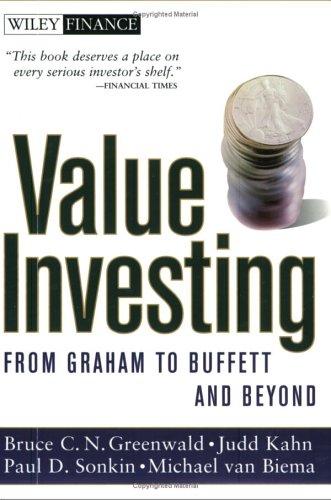
Value Investing: From Graham to Buffett and Beyond is Bruce Greenwald's attempt to update and extend the tradition that Benjamin Graham established.
Bruce Greenwald · 2001 · 5h 45m
Full summary and key takeaways →The 12 questions
- 1.
Greenwald argues that growth only creates value when returns exceed cost of capital. Can you think of a well-known company where investors are clearly paying for growth that fails this test?
- 2.
How would you estimate asset reproduction value for a company you know well? What makes that estimate hard, and what makes it easy?
- 3.
Greenwald distinguishes three sources of competitive advantage: customer captivity, cost advantage, and proprietary access. Which of these is most durable, and why?
- 4.
The book treats earnings power value as the most reliable anchor. What assumptions go into a normalized earnings estimate, and how do those assumptions change your conclusion?
- 5.
Warren Buffett evolved from a pure Graham 'cigar butt' approach to paying for quality franchises. What does that evolution suggest about when growth value is worth modeling?
- 6.
Where does the margin of safety concept break down? Are there businesses where even a deep discount isn't enough to compensate for the risks?
- 7.
How does competitive advantage analysis differ from the popular MOAT framework used in equity research? What does Greenwald add or subtract?
- 8.
Greenwald profiles several investors with different styles derived from Graham. Which investor profile in the book most resembles how you'd want to invest, and why?
- 9.
The book was published in 2001. What has changed since then that affects how value investors should apply these frameworks?
- 10.
Most individual investors don't have access to the same information as institutional players. How does that change which parts of this framework are practical?
- 11.
Greenwald argues most growth is value-neutral. How does that change how you'd evaluate a high-growth tech company versus a stable, mature business?
- 12.
What is the single biggest mistake value investors make in applying these valuation methods, based on what you've seen or read?
How to run the discussion
- Pick six to eight, not all of them. An hour of real discussion covers fewer questions than anyone expects, and racing the list is what makes a book club feel like homework.
- Open with what people noticed, not what they concluded. Asking for a verdict first hardens opinions before anyone has heard each other.
- Let the disagreement run. The questions below that split a room are the ones worth the time; the ones everyone answers the same way can be skipped.
- Ask the quiet person a specific question. A direct, narrow question is far easier to answer than an open invitation to contribute.
Themes worth steering toward
If the conversation stalls, these are the threads that usually restart it.
Common questions
What are good book club questions for Value Investing: From Graham to Buffett and Beyond?
Here are 12 book club questions for Value Investing: From Graham to Buffett and Beyond by Bruce Greenwald, ordered to open easily and end somewhere worth arguing about. The strongest openers ask what each reader noticed rather than what they concluded, and the discussion usually turns on value investing, intrinsic value, competitive advantage.
How long should a book club discussion of Value Investing: From Graham to Buffett and Beyond last?
Most groups run 60 to 90 minutes of actual discussion. That is roughly six to eight questions, not all of them, so pick the ones that suit your group rather than working down the list in order.
What are the main themes in Value Investing: From Graham to Buffett and Beyond?
Value investing, Intrinsic value, Competitive advantage, Security analysis, Portfolio management. Those are the threads most likely to divide a room, which makes them the useful places to steer a discussion that has gone quiet.
Picking the next one? See books like Value Investing: From Graham to Buffett and Beyond or questions for other book club picks.
