Talk to Vicious like its author wrote you back.
Get the ideas that fit your life — not generic summaries.
- Chat with the book
- Audiobook-style main ideas
- Adapts to your life and goals
- Helps you take action
Vicious, in detail
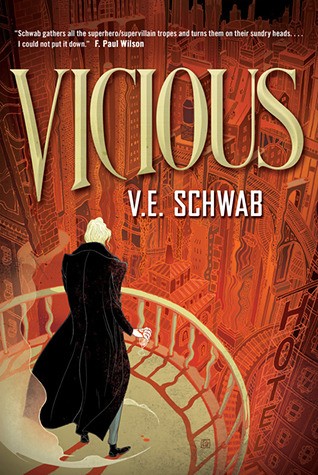
Vicious follows Victor Vale and Eli Cardale, two college roommates who discover through a thesis project that near-death experiences can create ExtraOrdinary humans — people with abilities. They use this knowledge to create those abilities in themselves. What should be a triumph breaks their friendship completely, and ten years later Victor escapes from prison to kill Eli, who has been using his own extraordinary ability to hunt and murder every other ExtraOrdinary he can find.
The novel is told in non-linear chapters that alternate between the college backstory and the present-day confrontation, and Schwab uses that structure to control when the reader understands each character's motivations. Both Victor and Eli believe themselves to be the protagonist of a story about stopping a villain; the reader spends the novel deciding which framing is closer to correct and arriving at the unsettling conclusion that both men are wrong about themselves in different ways.
Schwab is particularly good at the specific texture of rivalry between people who were once close. Victor and Eli's friendship was real, and what destroyed it — a collision of ego, ambition, and finally genuine moral difference — is rendered with more psychological specificity than the superhero genre usually bothers with. The ExtraOrdinary concept is genuinely interesting: the abilities are defined by the person's state of mind at the moment of near-death, which means the powers function as personality made literal.
Vicious is a fast, sharp novel that delivers what it promises: two compelling antagonists, a non-linear structure that rewards attention, and a moral framework that refuses easy answers. It's not trying to be literary fiction — the prose is clean and efficient rather than beautiful — but it's smarter than it looks and kinder than it seems. Readers who want moral complexity in genre packaging will find it a very satisfying read.
The big ideas
- 1.
Both Victor and Eli are wrong about themselves and right about each other. Schwab keeps both sides of that equation in view throughout, which is harder than it sounds.
- 2.
The ExtraOrdinary abilities are personality made literal — defined by what the character feared or wanted at the moment of near-death. That connection between psychology and superpower is the novel's best structural idea.
- 3.
The non-linear timeline is used to manage sympathy. The order in which information arrives changes how the reader aligns with Victor versus Eli. Rereading is rewarding.
