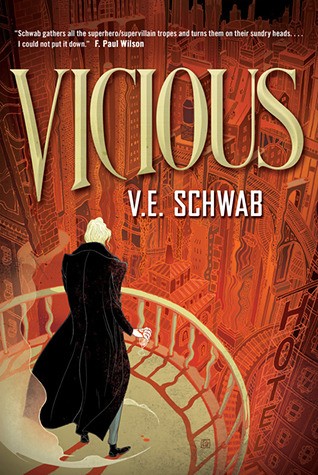
Vicious by V.E. Schwab is a 2013 fantasy book about moral ambiguity and villainy, obsession and rivalry, power and its costs. Both Victor and Eli are wrong about themselves and right about each other. Schwab keeps both sides of that equation in view throughout, which is harder than it sounds.
Summary
Vicious follows Victor Vale and Eli Cardale, two college roommates who discover through a thesis project that near-death experiences can create ExtraOrdinary humans — people with abilities. They use this knowledge to create those abilities in themselves. What should be a triumph breaks their friendship completely, and ten years later Victor escapes from prison to kill Eli, who has been using his own extraordinary ability to hunt and murder every other ExtraOrdinary he can find.
The novel is told in non-linear chapters that alternate between the college backstory and the present-day confrontation, and Schwab uses that structure to control when the reader understands each character's motivations. Both Victor and Eli believe themselves to be the protagonist of a story about stopping a villain; the reader spends the novel deciding which framing is closer to correct and arriving at the unsettling conclusion that both men are wrong about themselves in different ways.
Schwab is particularly good at the specific texture of rivalry between people who were once close. Victor and Eli's friendship was real, and what destroyed it — a collision of ego, ambition, and finally genuine moral difference — is rendered with more psychological specificity than the superhero genre usually bothers with. The ExtraOrdinary concept is genuinely interesting: the abilities are defined by the person's state of mind at the moment of near-death, which means the powers function as personality made literal.
Vicious is a fast, sharp novel that delivers what it promises: two compelling antagonists, a non-linear structure that rewards attention, and a moral framework that refuses easy answers. It's not trying to be literary fiction — the prose is clean and efficient rather than beautiful — but it's smarter than it looks and kinder than it seems. Readers who want moral complexity in genre packaging will find it a very satisfying read.
Talk to Vicious like its author wrote you back.
Get the ideas that fit your life — not generic summaries.
- Chat with the book
- Audiobook-style main ideas
- Adapts to your life and goals
- Helps you take action
Key takeaways
- 1.
Both Victor and Eli are wrong about themselves and right about each other. Schwab keeps both sides of that equation in view throughout, which is harder than it sounds.
- 2.
The ExtraOrdinary abilities are personality made literal — defined by what the character feared or wanted at the moment of near-death. That connection between psychology and superpower is the novel's best structural idea.
- 3.
The non-linear timeline is used to manage sympathy. The order in which information arrives changes how the reader aligns with Victor versus Eli. Rereading is rewarding.
- 4.
Eli believes he is doing God's work. Victor believes he is doing rational work. Neither of them is checking their assumptions against reality. That's the moral.
- 5.
Mitch and Sydney — Victor's two companions — are the most purely sympathetic characters in the novel, which is a structural choice: they show what Victor could be without the obsession.
- 6.
The novel argues that the line between hero and villain is largely about whose story you're following, which is familiar but earned here because Schwab actually follows both.
- 7.
Schwab's pacing is excellent. The book never drags, the chapter breaks are well-placed, and the structural reveals land at the right moments.
- 8.
Sydney Carew is the emotional center of the novel, even though she's not the protagonist. Her situation and her choices are what give the ending weight.
Discussion questions
Use these on your own, with a book club, or as chat starters in Superbook. Book club version, ready to copy or print →
- 1.
By the end, did you decide that Victor or Eli was the villain? Or does the novel make that distinction meaningless?
- 2.
Eli frames his killing of ExtraOrdinaries as religious obligation. Does the novel treat that as delusion, or as a coherent worldview it takes seriously?
- 3.
Victor is capable of genuine loyalty — to Mitch, to Sydney — but not to Eli. What changed?
- 4.
The ExtraOrdinary abilities are defined by near-death psychology. What ability do you think you'd develop, based on what you'd fear most in that moment?
- 5.
Sydney is twelve years old and her ability is raising the dead. The novel doesn't make her a victim of that — she has genuine agency. Did that feel true?
- 6.
The non-linear structure means we know from early chapters that things go badly. Did dramatic irony help or hurt your engagement with the college flashbacks?
- 7.
Eli's thesis was about what makes people extraordinary. Do you think the novel answers that question, or just complicates it?
- 8.
Victor escapes from prison at the start of the novel for revenge. Does the reader ever fully know whether that's the only reason?
- 9.
Schwab gives both characters their own supporting ensemble. Mitch and Sydney versus Eli's institutional allies. How do those secondary characters define the two protagonists?
- 10.
The novel has been described as a superhero story without heroes. Is that frame accurate, or is that too cynical about what it's doing?
- 11.
Vicious was followed by Vengeful. Does the first book feel complete as a standalone, or does it require the sequel to resolve properly?
- 12.
What does the novel say about what ambition does to friendships, as distinct from what it does to the people individually?
Themes
Frequently asked questions
-
Is Vicious worth reading?
Yes — it's a fast, smart genre novel that delivers moral complexity without being slow or pretentious about it. The dual-protagonist structure works well, the reveals are satisfying, and the ending is earned. It's one of the better superhero-adjacent novels published in the 2010s.
-
Is this a superhero novel?
Adjacent to one, but it's really a villain novel — or more accurately a novel in which both protagonists think the other is the villain. It uses superhero-style powers as its conceit but is far more interested in psychology and rivalry than in action and heroism.
-
How dark is Vicious?
Quite dark — there is violence, death including of secondary characters who didn't deserve it, and a moral framework in which neither protagonist is clearly good. It is not gratuitously grim but it's not safe either. Suitable for adults who like morally complex genre fiction.
-
Who shouldn't read Vicious?
Readers who need a rooting-for-able protagonist. Readers who dislike non-linear narratives. Readers who find the superhero genre fundamentally uninteresting and don't think moral complexity can redeem it.
-
Do I need to read the sequel, Vengeful?
Vicious resolves its central conflict and functions as a standalone. Vengeful, published in 2018, picks up with consequences from the first book and introduces new antagonists. Most readers feel the first book is tighter; the sequel is rewarding if you want more of the world.