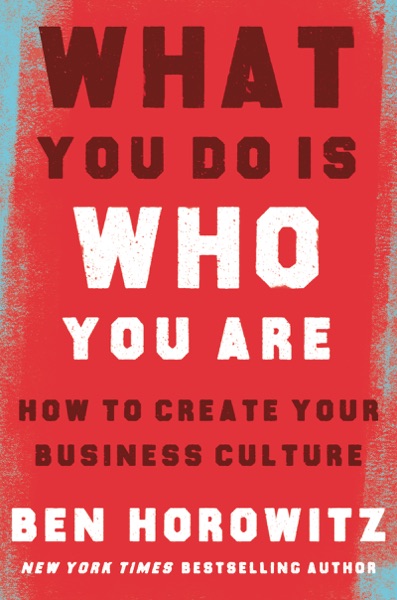
Talk to What You Do Is Who You Are like its author wrote you back.
Get the ideas that fit your life — not generic summaries.
- Chat with the book
- Audiobook-style main ideas
- Adapts to your life and goals
- Helps you take action
What You Do Is Who You Are, in detail
What You Do Is Who You Are is Ben Horowitz's argument that company culture is not what you say it is — it's what you do. Horowitz, the co-founder of Andreessen Horowitz and the author of The Hard Thing About Hard Things, builds his case through four historical figures: Toussaint Louverture, the leader of the Haitian Revolution; Shaka Senghor, a convicted murderer who transformed prison culture; Genghis Khan, who built a meritocratic culture that conquered most of the known world; and the samurai of feudal Japan, whose code of bushido embedded values through practice rather than decree. The choice of examples is deliberately unusual — Horowitz wants to show that the principles of culture-building appear across contexts, not just in Silicon Valley.
The core argument is that culture is shaped by the actions leaders take, especially in difficult situations. If a CEO preaches honesty but doesn't fire the executive who lies, the culture learns that dishonesty is acceptable. If a manager says they value hard work but lets high performers leave for better offers elsewhere, the culture learns that hard work doesn't get rewarded. The gap between stated values and actual behavior destroys cultures faster than no stated values at all, because hypocrisy corrodes trust in a way that silence does not.
Horowitz is particularly focused on cultural artifacts — specific behaviors, symbols, stories, and practices that carry meaning. He argues that cultures need concrete, memorable practices that people can actually follow rather than vague aspirational statements. The example he returns to is an Amazon practice of leaving an empty chair in meetings to represent the customer; or a specific rule at his own company about interrupting senior people. These aren't arbitrary rituals — they communicate what the organization actually values through consistent, repeated action.
The book is practical and anecdotal rather than theoretical. Horowitz writes from his own experience as CEO, investor, and observer of dozens of companies, and the texture is specific and honest. He acknowledges where he failed, where culture building in startups is genuinely hard, and where the historical examples he finds inspiring have obvious limits and dark sides. The result is a useful and readable book on one of management's most talked-about and least understood topics.
The big ideas
- 1.
Culture is not what you say — it's what you do, particularly what you do when it's costly or inconvenient. The gap between stated values and actual behavior destroys trust faster than silence.
- 2.
Toussaint Louverture built a revolutionary army out of enslaved people by using cultural practices — specific rules, symbols, and behaviors — to signal the new order and enforce it consistently.
- 3.
Shocking rules can be a feature, not a bug. An unexpected or counterintuitive rule signals that your culture is genuinely different, makes people pay attention, and tests whether leaders will enforce it.
