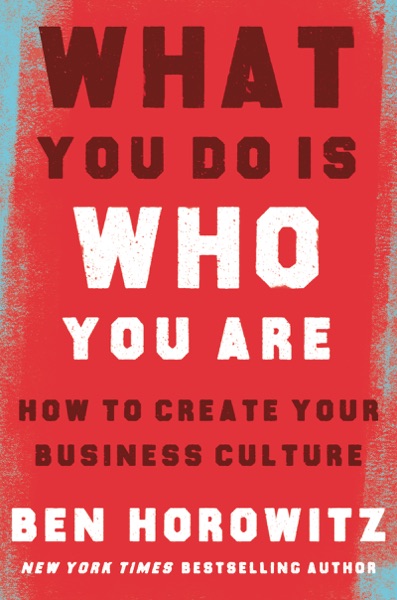
What You Do Is Who You Are by Ben Horowitz is a 2019 business book about company culture, leadership, management. Culture is not what you say — it's what you do, particularly what you do when it's costly or inconvenient. The gap between stated values and actual behavior destroys trust faster than silence.
Summary
What You Do Is Who You Are is Ben Horowitz's argument that company culture is not what you say it is — it's what you do. Horowitz, the co-founder of Andreessen Horowitz and the author of The Hard Thing About Hard Things, builds his case through four historical figures: Toussaint Louverture, the leader of the Haitian Revolution; Shaka Senghor, a convicted murderer who transformed prison culture; Genghis Khan, who built a meritocratic culture that conquered most of the known world; and the samurai of feudal Japan, whose code of bushido embedded values through practice rather than decree. The choice of examples is deliberately unusual — Horowitz wants to show that the principles of culture-building appear across contexts, not just in Silicon Valley.
The core argument is that culture is shaped by the actions leaders take, especially in difficult situations. If a CEO preaches honesty but doesn't fire the executive who lies, the culture learns that dishonesty is acceptable. If a manager says they value hard work but lets high performers leave for better offers elsewhere, the culture learns that hard work doesn't get rewarded. The gap between stated values and actual behavior destroys cultures faster than no stated values at all, because hypocrisy corrodes trust in a way that silence does not.
Horowitz is particularly focused on cultural artifacts — specific behaviors, symbols, stories, and practices that carry meaning. He argues that cultures need concrete, memorable practices that people can actually follow rather than vague aspirational statements. The example he returns to is an Amazon practice of leaving an empty chair in meetings to represent the customer; or a specific rule at his own company about interrupting senior people. These aren't arbitrary rituals — they communicate what the organization actually values through consistent, repeated action.
The book is practical and anecdotal rather than theoretical. Horowitz writes from his own experience as CEO, investor, and observer of dozens of companies, and the texture is specific and honest. He acknowledges where he failed, where culture building in startups is genuinely hard, and where the historical examples he finds inspiring have obvious limits and dark sides. The result is a useful and readable book on one of management's most talked-about and least understood topics.
Talk to What You Do Is Who You Are like its author wrote you back.
Get the ideas that fit your life — not generic summaries.
- Chat with the book
- Audiobook-style main ideas
- Adapts to your life and goals
- Helps you take action
Key takeaways
- 1.
Culture is not what you say — it's what you do, particularly what you do when it's costly or inconvenient. The gap between stated values and actual behavior destroys trust faster than silence.
- 2.
Toussaint Louverture built a revolutionary army out of enslaved people by using cultural practices — specific rules, symbols, and behaviors — to signal the new order and enforce it consistently.
- 3.
Shocking rules can be a feature, not a bug. An unexpected or counterintuitive rule signals that your culture is genuinely different, makes people pay attention, and tests whether leaders will enforce it.
- 4.
Virtue is habitual, not innate. Cultures that produce ethical behavior do so by building habits and practices, not by hiring people who are already virtuous.
- 5.
The samurai code worked not because of explicit enforcement but because it was internalized through training, ritual, and story until it shaped automatic behavior.
- 6.
Genghis Khan's meritocracy — promoting based on competence rather than birth, rewarding loyalty with spoils — was radical for its time and central to Mongol military effectiveness.
- 7.
Inclusion is a culture problem, not a hiring problem. If you hire diverse people into an unchanged culture, they leave. The culture must actually change or nothing else matters.
- 8.
Every company has a culture. The question is only whether you designed it deliberately or let it form by accident from the behaviors you tolerated in the first years.
Discussion questions
Use these on your own, with a book club, or as chat starters in Superbook. Book club version, ready to copy or print →
- 1.
Horowitz argues culture is set by actions, not words. Identify a moment in an organization you've been part of where a leader's action — under pressure — defined the actual culture.
- 2.
The historical examples Horowitz chooses — Toussaint, Shaka Senghor, Genghis Khan, samurai — are unusual for a business book. What does that choice signal about his argument, and do the examples hold up?
- 3.
What's a shocking or counterintuitive rule that might signal what you actually value in your organization? Could you enforce it consistently?
- 4.
Horowitz distinguishes between culture and ethics — great cultures have produced terrible outcomes. How do you think about that separation in practice?
- 5.
The book argues that diversity is a culture problem. If you've seen this in practice, what specifically made the culture inhospitable, and was it fixable?
- 6.
Horowitz is honest about his own failures as a CEO. Which failure of his resonates most with what you've seen or done in leadership roles?
- 7.
Shaka Senghor transformed a prison culture with no formal authority. What principles from his example apply to changing culture when you're not at the top of the hierarchy?
- 8.
What story does your current organization tell to newcomers about who the heroes are and what gets rewarded? Is it the story you want to be telling?
- 9.
The book argues that cultural artifacts — specific practices, stories, symbols — carry more meaning than mission statements. Which specific practice in your organization most clearly communicates what you value?
- 10.
Genghis Khan's meritocracy worked in service of conquest. What does it mean to separate the cultural mechanisms from the ends they're pointed toward?
- 11.
Horowitz writes about the tension between preserving culture as you scale and letting it evolve. At what point is cultural evolution healthy versus cultural drift?
- 12.
What would it look like to build a culture in your organization that would make you proud if it became a historical case study in 50 years?
Themes
Frequently asked questions
-
Is What You Do Is Who You Are worth reading?
Yes for founders and managers, particularly those building organizations from scratch or trying to fix a culture that has drifted. The historical examples make it more interesting than most culture books, and Horowitz is honest about difficulty and failure in a way that generic management books rarely are.
-
How does this compare to The Hard Thing About Hard Things?
The Hard Thing is more about operational crisis management — what to do when things go badly wrong as a CEO. This book is more focused specifically on culture and values. Both are practical and experience-grounded. Most readers find The Hard Thing the better starting point; this one is a natural follow-on.
-
What is the main idea of What You Do Is Who You Are?
Culture is defined by behavior under pressure, not by stated values. Leaders who want to build a specific culture must take visible, consistent actions that demonstrate that culture — especially when it's costly — and design concrete practices that make the culture's values habitual.
-
Who should read this book?
Founders building their first culture, executives trying to change a broken one, and managers curious about why their organization doesn't behave the way leadership intends. Less useful for individual contributors or people whose role doesn't involve shaping others' behavior.
-
What's the most actionable idea in the book?
The 'shocking rule' concept: design one explicit rule that is counterintuitive, memorable, and tests whether your stated culture is real. If you can enforce it consistently, it proves the culture is genuine. If you can't, it exposes the gap between what you say and what you do.
Similar books
The Hard Thing About Hard Things
Ben Horowitz
No Rules Rules: Netflix and the Culture of Reinvention
Reed Hastings and Erin Meyer
The Culture Code
Daniel Coyle
Good to Great
Jim Collins
