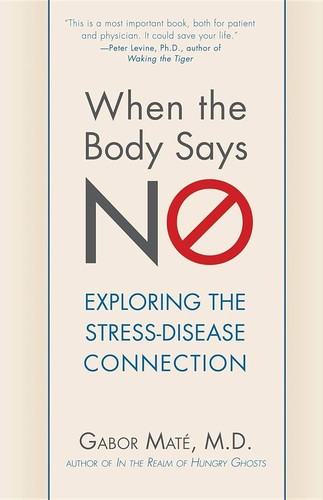
Talk to When the Body Says No like its author wrote you back.
Get the ideas that fit your life — not generic summaries.
- Chat with the book
- Audiobook-style main ideas
- Adapts to your life and goals
- Helps you take action
What it argues
When the Body Says No is Gabor Maté's investigation into how chronic stress and emotional suppression contribute to serious illness. Maté spent decades practicing medicine in Vancouver, including years treating people with cancer, multiple sclerosis, ALS, and autoimmune conditions. What he noticed again and again was a pattern: patients who consistently put others' needs ahead of their own, who could not say no, who had difficulty identifying or expressing their own emotions. His argument is that the body, when the conscious mind refuses to acknowledge distress, finds its own way of saying no — through disease.
The book is built around case studies, many drawn from Maté's own patients, woven together with research from psychoneuroimmunology, the field studying how psychological states affect the nervous and immune systems. The science is real: chronic stress elevates cortisol and inflammatory markers, suppresses immune surveillance, and disrupts hormonal balance. Maté's contribution is to link this physiology to specific emotional patterns — compulsive self-sufficiency, people-pleasing, the inability to feel or express anger — that he traces back to early childhood environments where emotional authenticity was not safe.
What it gets right
- 1.
The mind and body are not separate systems. Chronic emotional stress — especially suppressed anger and unmet emotional needs — has measurable physiological consequences, including immune suppression.
- 2.
People who consistently cannot say no, who prioritize others' wellbeing at the expense of their own emotional needs, show up disproportionately in the case histories of serious chronic illness.
- 3.
The emotional patterns most associated with disease risk are not random. They often trace back to early environments where a child learned that expressing genuine emotion was unsafe or unwelcome.
What it covers
Who wrote it
Gabor Maté is a Hungarian-Canadian physician and author who practiced family medicine in Vancouver for over two decades, including work with patients facing addiction, chronic illness, and palliative care. He is known for his work connecting early childhood trauma to adult health outcomes, and for his advocacy of compassion-based approaches to addiction. His other books include Scattered Minds, In the Realm of Hungry Ghosts, and The Myth of Normal. Maté received the Order of Canada in 2018 and has lectured widely on trauma, attachment, and the social roots of illness.
