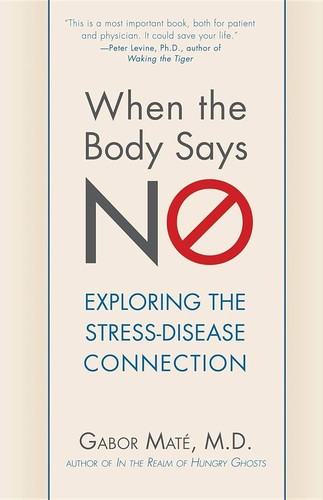
Talk to When the Body Says No like its author wrote you back.
Get the ideas that fit your life — not generic summaries.
- Chat with the book
- Audiobook-style main ideas
- Adapts to your life and goals
- Helps you take action
When the Body Says No, in detail
When the Body Says No is Gabor Maté's investigation into how chronic stress and emotional suppression contribute to serious illness. Maté spent decades practicing medicine in Vancouver, including years treating people with cancer, multiple sclerosis, ALS, and autoimmune conditions. What he noticed again and again was a pattern: patients who consistently put others' needs ahead of their own, who could not say no, who had difficulty identifying or expressing their own emotions. His argument is that the body, when the conscious mind refuses to acknowledge distress, finds its own way of saying no — through disease.
The book is built around case studies, many drawn from Maté's own patients, woven together with research from psychoneuroimmunology, the field studying how psychological states affect the nervous and immune systems. The science is real: chronic stress elevates cortisol and inflammatory markers, suppresses immune surveillance, and disrupts hormonal balance. Maté's contribution is to link this physiology to specific emotional patterns — compulsive self-sufficiency, people-pleasing, the inability to feel or express anger — that he traces back to early childhood environments where emotional authenticity was not safe.
Maté is careful not to blame the sick. The patterns he describes are adaptive responses to circumstances, often childhood environments where expressing need or emotion was dangerous or unwelcome. A child who learns to suppress their feelings to preserve attachment to caregivers is doing something sensible. The tragedy is that the same adaptation, carried into adult life, becomes a source of biological stress the body cannot sustain indefinitely.
The book has flaws. Some of the case studies are presented with a certainty about causation that the evidence doesn't fully support, and critics have noted that not everyone who suppresses emotion develops the conditions Maté describes. But as a provocation to think differently about illness — and about what it means to live in a body while systematically ignoring its signals — the book is difficult to dismiss. Maté asks the reader to consider not just what happens to us, but what happens inside us as a result.
The big ideas
- 1.
The mind and body are not separate systems. Chronic emotional stress — especially suppressed anger and unmet emotional needs — has measurable physiological consequences, including immune suppression.
- 2.
People who consistently cannot say no, who prioritize others' wellbeing at the expense of their own emotional needs, show up disproportionately in the case histories of serious chronic illness.
- 3.
The emotional patterns most associated with disease risk are not random. They often trace back to early environments where a child learned that expressing genuine emotion was unsafe or unwelcome.
