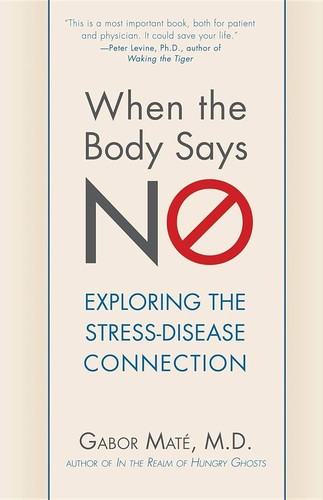
When the Body Says No by Gabor Maté is a 2003 health book about mind-body connection, stress, trauma. The mind and body are not separate systems. Chronic emotional stress — especially suppressed anger and unmet emotional needs — has measurable physiological consequences, including immune suppression.
Summary
When the Body Says No is Gabor Maté's investigation into how chronic stress and emotional suppression contribute to serious illness. Maté spent decades practicing medicine in Vancouver, including years treating people with cancer, multiple sclerosis, ALS, and autoimmune conditions. What he noticed again and again was a pattern: patients who consistently put others' needs ahead of their own, who could not say no, who had difficulty identifying or expressing their own emotions. His argument is that the body, when the conscious mind refuses to acknowledge distress, finds its own way of saying no — through disease.
The book is built around case studies, many drawn from Maté's own patients, woven together with research from psychoneuroimmunology, the field studying how psychological states affect the nervous and immune systems. The science is real: chronic stress elevates cortisol and inflammatory markers, suppresses immune surveillance, and disrupts hormonal balance. Maté's contribution is to link this physiology to specific emotional patterns — compulsive self-sufficiency, people-pleasing, the inability to feel or express anger — that he traces back to early childhood environments where emotional authenticity was not safe.
Maté is careful not to blame the sick. The patterns he describes are adaptive responses to circumstances, often childhood environments where expressing need or emotion was dangerous or unwelcome. A child who learns to suppress their feelings to preserve attachment to caregivers is doing something sensible. The tragedy is that the same adaptation, carried into adult life, becomes a source of biological stress the body cannot sustain indefinitely.
The book has flaws. Some of the case studies are presented with a certainty about causation that the evidence doesn't fully support, and critics have noted that not everyone who suppresses emotion develops the conditions Maté describes. But as a provocation to think differently about illness — and about what it means to live in a body while systematically ignoring its signals — the book is difficult to dismiss. Maté asks the reader to consider not just what happens to us, but what happens inside us as a result.
Talk to When the Body Says No like its author wrote you back.
Get the ideas that fit your life — not generic summaries.
- Chat with the book
- Audiobook-style main ideas
- Adapts to your life and goals
- Helps you take action
Key takeaways
- 1.
The mind and body are not separate systems. Chronic emotional stress — especially suppressed anger and unmet emotional needs — has measurable physiological consequences, including immune suppression.
- 2.
People who consistently cannot say no, who prioritize others' wellbeing at the expense of their own emotional needs, show up disproportionately in the case histories of serious chronic illness.
- 3.
The emotional patterns most associated with disease risk are not random. They often trace back to early environments where a child learned that expressing genuine emotion was unsafe or unwelcome.
- 4.
Psychoneuroimmunology research shows that psychological states — loneliness, hostility, grief, chronic stress — directly affect the nervous system's regulation of immune function and inflammation.
- 5.
Illness can serve as the body's way of drawing a boundary the conscious mind refused to draw. The 'no' that was never spoken in relationships appears eventually in the body.
- 6.
The inability to feel or articulate anger — not aggression, but healthy self-protective anger — is a recurring feature in Maté's case studies, particularly among patients with autoimmune and inflammatory conditions.
- 7.
Healing, in Maté's framing, involves learning to recognize and honor one's own emotional states, not just treating the physical symptoms. This requires rethinking what 'selfish' means.
- 8.
Early attachment relationships shape our adult emotional physiology. Children who don't experience safe emotional mirroring develop chronic stress patterns that are biologically embedded before they can articulate them.
Discussion questions
Use these on your own, with a book club, or as chat starters in Superbook. Book club version, ready to copy or print →
- 1.
Maté argues that people who cannot say no are at elevated disease risk. Do you recognize that pattern in yourself or someone close to you, and what would it cost to change it?
- 2.
The book distinguishes between physical pain and emotional pain that gets converted into physical symptoms. How confident are you that you can tell the difference in your own experience?
- 3.
Maté traces adult emotional patterns back to childhood attachment. What emotional rules did you absorb growing up about what feelings were acceptable to express?
- 4.
Which relationships in your life require you to suppress something in order to keep the peace? What is the cumulative cost of that suppression?
- 5.
The research Maté cites shows that loneliness affects immune function measurably. What does genuine connection look like in your life, versus connection that requires you to perform?
- 6.
Maté argues the inability to feel anger is more dangerous than expressing it. Is that true in your experience — do you find it easier to accommodate than to set limits?
- 7.
The book suggests illness is sometimes the body enforcing the boundaries the person could not. Has your own body ever communicated something you were not consciously acknowledging?
- 8.
How do you respond when someone in your life is sick? Does Maté's framing change how you think about their illness or the circumstances around it?
- 9.
Maté is careful to say he is not blaming patients for their illness. Do you find his argument exonerating, or does it still feel like it implies personal responsibility for disease?
- 10.
What would it mean to take your own emotional needs as seriously as you take other people's? What would have to change?
- 11.
The book covers conditions ranging from cancer to MS to rheumatoid arthritis. Are you persuaded that the same emotional mechanisms apply across such different diseases?
- 12.
Maté draws on his own history — including his ADHD and workaholism — as data. Does his willingness to implicate himself make the argument more or less credible?
Themes
Frequently asked questions
-
What is When the Body Says No about?
It examines how chronic stress and emotional suppression — particularly the inability to say no or express anger — contribute to serious illnesses including cancer, autoimmune conditions, and ALS. Maté combines case studies from his medical practice with research from psychoneuroimmunology.
-
Is When the Body Says No scientifically credible?
The psychoneuroimmunology research Maté cites is real and well-established. The specific causal claims about individual patients are harder to verify, and some critics argue he overstates how much emotional patterns determine disease outcomes. It's best read as a serious provocation rather than a clinical manual.
-
Who should read When the Body Says No?
People dealing with chronic illness who want to think differently about its roots. Also useful for caregivers, therapists, and anyone who recognizes a pattern of self-suppression in themselves. It's not a self-help book with prescriptions — it's more diagnostic than prescriptive.
-
Does Maté blame sick people for their illness?
He explicitly tries not to. The argument is that the emotional patterns he describes are adaptive responses to difficult environments, not character flaws. Whether readers experience it as blame-free depends somewhat on how they receive the material.
-
How long is When the Body Says No?
Roughly 300 pages, which takes about five to six hours to read. The chapter structure alternates between case studies and the underlying science, so it's accessible even if you have no medical background.
Similar books
The Body Keeps the Score
Bessel van der Kolk
The Upside of Stress
Kelly McGonigal
Being Mortal: Medicine and What Matters in the End
Atul Gawande
The Man Who Mistook His Wife for a Hat
Oliver Sacks
