Talk to Where Is My Flying Car? like its author wrote you back.
Get the ideas that fit your life — not generic summaries.
- Chat with the book
- Audiobook-style main ideas
- Adapts to your life and goals
- Helps you take action
What it argues
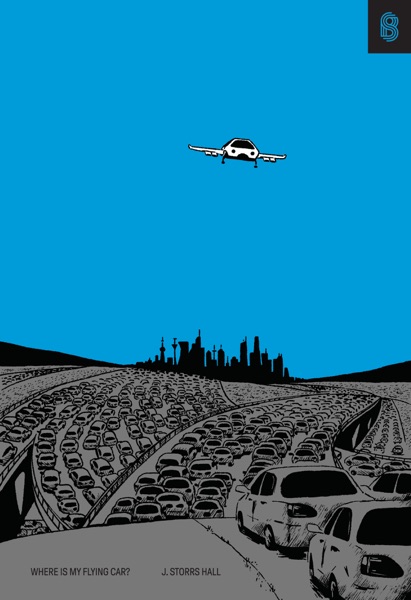
Where Is My Flying Car? is J. Storrs Hall's extended argument that the rate of technological progress in the physical world—energy, transportation, manufacturing, construction—slowed dramatically after roughly 1970, and that this slowdown was not inevitable but was caused by specific policy choices, cultural shifts, and institutional failures. Hall is a nanotechnology researcher and AI scientist, and the book draws on decades of his own technical work alongside a broad reading of economic and historical literature.
Hall's diagnosis begins with energy. The postwar decades saw extraordinary growth in energy production and consumption, with nuclear power expected to deliver effectively unlimited cheap electricity. That trajectory ended around 1970, when growth in energy use per capita in the United States essentially stopped, despite continued population and economic growth. Hall argues this plateau wasn't caused by physical limits—the resources and technology for continued growth existed—but by a collapse of regulatory will, cultural attitudes toward risk, and the specific political defeat of nuclear power.
What it gets right
- 1.
Energy use per capita in the US stopped growing around 1970, despite no physical constraint requiring that plateau. Hall argues the stagnation was chosen, not inevitable.
- 2.
Nuclear power's defeat was a turning point. The technology worked; what failed was the political and regulatory environment, shaped in part by coordinated opposition that Hall documents in detail.
- 3.
The same post-1970 regulatory environment that stopped nuclear power slowed progress in aviation, chemistry, construction, and transportation. The pattern was not sector-specific but systemic.
What it covers
Who wrote it
J. Storrs Hall is an American researcher and author with a background in artificial intelligence and nanotechnology. He was a research fellow at the Institute for Molecular Manufacturing and a research scientist at Rutgers University. His previous books include Nanofuture and Beyond AI. He is a founder of the Foresight Institute's nanotechnology program and has written extensively on the technical feasibility of molecular manufacturing. Where Is My Flying Car?, published in 2021, draws on his decades of work in both technical research and technological history.
