Where Is My Flying Car? by J. Storrs Hall is a 2021 science book about technological stagnation, energy, innovation. Energy use per capita in the US stopped growing around 1970, despite no physical constraint requiring that plateau. Hall argues the stagnation was chosen, not inevitable.
Summary
Where Is My Flying Car? is J. Storrs Hall's extended argument that the rate of technological progress in the physical world—energy, transportation, manufacturing, construction—slowed dramatically after roughly 1970, and that this slowdown was not inevitable but was caused by specific policy choices, cultural shifts, and institutional failures. Hall is a nanotechnology researcher and AI scientist, and the book draws on decades of his own technical work alongside a broad reading of economic and historical literature.
Hall's diagnosis begins with energy. The postwar decades saw extraordinary growth in energy production and consumption, with nuclear power expected to deliver effectively unlimited cheap electricity. That trajectory ended around 1970, when growth in energy use per capita in the United States essentially stopped, despite continued population and economic growth. Hall argues this plateau wasn't caused by physical limits—the resources and technology for continued growth existed—but by a collapse of regulatory will, cultural attitudes toward risk, and the specific political defeat of nuclear power.
The book builds an ambitious case that the same forces that stopped nuclear energy also slowed or reversed progress in aviation (supersonic commercial flight was abandoned), chemistry (regulatory barriers multiplied), construction (high-rises became harder to build), and personal transport (car performance plateaued even as computational power exploded). Hall calls this period "The Great Stagnation" and argues that Tyler Cowen's similarly titled book identifies the symptom correctly but misdiagnoses the cause. It wasn't that the low-hanging fruit of technology had been picked; it was that the institutional environment turned hostile to the kind of risk-taking that technological progress requires.
The second half of the book is more speculative, projecting what might have been achieved—and what might yet be—in nanotechnology, molecular manufacturing, and personal air vehicles. Hall's enthusiasm for technology is evident throughout, and his technical background gives the projections more grounding than most futurism. But readers who don't share his priors about the benefits of energy abundance and minimal regulation will find the political argument one-sided. The book is at its strongest as historical diagnosis and most strained as political prescription.

Talk to Where Is My Flying Car? like its author wrote you back.
Get the ideas that fit your life — not generic summaries.
- Chat with the book
- Audiobook-style main ideas
- Adapts to your life and goals
- Helps you take action
Key takeaways
- 1.
Energy use per capita in the US stopped growing around 1970, despite no physical constraint requiring that plateau. Hall argues the stagnation was chosen, not inevitable.
- 2.
Nuclear power's defeat was a turning point. The technology worked; what failed was the political and regulatory environment, shaped in part by coordinated opposition that Hall documents in detail.
- 3.
The same post-1970 regulatory environment that stopped nuclear power slowed progress in aviation, chemistry, construction, and transportation. The pattern was not sector-specific but systemic.
- 4.
Hall distinguishes between progress in information technology—which continued and accelerated—and progress in physical technology, which stalled. Moore's Law has no equivalent in energy, transportation, or materials.
- 5.
Flying cars are not technically impossible. Hall argues the barriers are regulatory and economic, not physical, and that several design approaches have been viable for decades.
- 6.
The cost of regulatory compliance has grown faster than the technology it governs in most physical sectors. This creates a ratchet effect where incumbents can use regulation to block new entrants.
- 7.
Cultural attitudes toward risk shifted substantially after roughly 1970. Hall argues this shift—the 'safety-ism' in his framing—has real economic costs that rarely appear in the accounting of regulatory benefits.
- 8.
Molecular nanotechnology, if it develops as Hall projects, would sidestep many of the constraints that have limited physical technology for the past 50 years. Whether that projection is credible is a genuine open question.
Discussion questions
Use these on your own, with a book club, or as chat starters in Superbook. Book club version, ready to copy or print →
- 1.
Hall argues the post-1970 technological plateau was caused by specific choices, not physical limits. What evidence would you need to see to be convinced that's the right diagnosis?
- 2.
The defeat of nuclear power in the 1970s is Hall's central case study. Do you think the outcome was a mistake, a reasonable response to genuine risks, or something more complicated?
- 3.
The gap between progress in information technology and progress in physical technology is striking. Why do you think those two tracks diverged so dramatically after 1970?
- 4.
Hall makes a regulatory-capture argument: that regulations ostensibly designed to protect the public often end up protecting incumbents from competition. Where do you see that pattern, and where do you think it's overstated?
- 5.
What's the strongest counterargument to Hall's thesis that the Great Stagnation was a policy failure rather than a reflection of genuine physical or economic limits?
- 6.
If Hall's flying car projection had been realized—personal air vehicles by 2000—what would cities, suburbs, and transportation networks look like today?
- 7.
Hall is explicitly pro-energy-abundance and skeptical of the environmental movement's anti-growth wing. Does that framing help or hurt his argument for readers who don't share those priors?
- 8.
The book distinguishes between legitimate safety regulation and performative regulation that creates costs without proportionate benefits. How would you draw that line?
- 9.
Which of Hall's historical case studies—nuclear, supersonic flight, construction—do you find most persuasive? Which least persuasive?
- 10.
If the regulatory environment loosened substantially in the next decade, which physical technologies do you think are closest to breakthrough, and which would remain stuck?
- 11.
The book is a work of technological optimism written from a libertarian perspective. How do you separate the technical claims from the political ones, and does that separation matter?
Themes
Frequently asked questions
-
What is Where Is My Flying Car? actually about?
The book's central argument is that technological progress in physical domains—energy, transportation, materials—stalled after 1970 due to policy and cultural choices, not physical limits. The flying car is a symbol of broader technological ambitions that were abandoned.
-
Is Where Is My Flying Car? politically one-sided?
Yes, substantially. Hall's argument is sympathetic to deregulation and skeptical of environmental and safety regulation. Readers who share those priors will find the argument compelling; others will need to separate the empirical historical claims from the political prescriptions.
-
Is the technical content accessible to non-scientists?
Mostly. Hall explains technical concepts clearly, and the historical and economic arguments don't require scientific background. The nanotechnology sections in the latter half are more specialized but can be read at a surface level.
-
Who should read Where Is My Flying Car?
Anyone interested in the economics of innovation, energy policy history, or the question of why physical technology hasn't advanced as fast as digital technology. It's also worth reading as a counterpoint to books that treat the current pace of technological progress as natural or inevitable.
-
What's the most interesting empirical claim in the book?
That energy use per capita in the US has been essentially flat since 1970 despite continued population and economic growth, and that this plateau correlates with specific policy changes rather than physical limits. Whether Hall's causal interpretation is right is debatable, but the empirical fact is striking.
Similar books
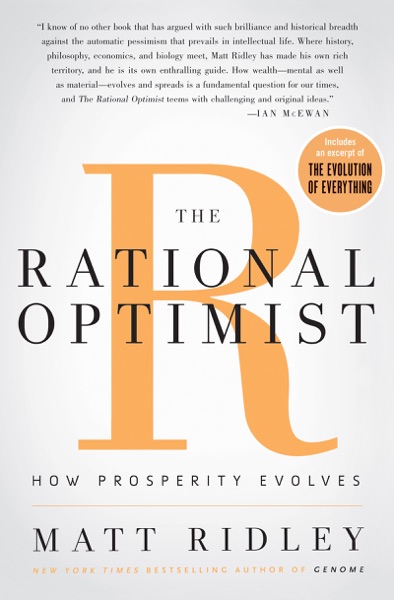
The Rational Optimist: How Prosperity Evolves
Matt Ridley

Enlightenment Now
Steven Pinker
Why Nations Fail: The Origins of Power, Prosperity, and Poverty
Daron Acemoglu and James A. Robinson

The Second Machine Age
Erik Brynjolfsson and Andrew McAfee
