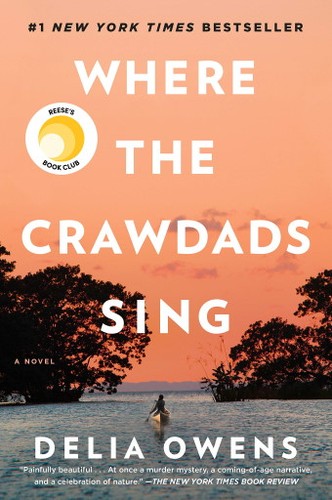
Talk to Where the Crawdads Sing like its author wrote you back.
Get the ideas that fit your life — not generic summaries.
- Chat with the book
- Audiobook-style main ideas
- Adapts to your life and goals
- Helps you take action
Where the Crawdads Sing, in detail
Where the Crawdads Sing tells two stories in alternating time frames. In the 1950s and 1960s, Kya Clark is growing up alone in the North Carolina marsh after her family abandons her one by one, leaving a child to feed herself and survive in a landscape most people in the nearby town regard as worthless and wild. In 1969, a local man is found dead, and the investigation circles back to Kya, now known as the Marsh Girl — an adult woman who has lived in isolation so long that she has become a kind of myth.
The book's great strength is the marsh itself. Owens is a wildlife scientist, and the North Carolina coastal wetland in these pages is rendered with the specificity of someone who actually knows it: the species, the light, the seasons, the particular texture of a place that is simultaneously beautiful and capable of killing you. Kya's relationship to the marsh — she becomes a naturalist by necessity, then by vocation — gives the book its most convincing and affecting material. When the novel is about nature, it is genuinely good.
The human drama is more conventional. The romance plots that run through Kya's story follow predictable shapes — the boy who seems good and isn't, the man who seems right and might be — and the courtroom thriller in the 1969 frame relies on a twist that divides readers sharply. Owens is sentimental about her protagonist in ways that can feel like special pleading; the deck is stacked against Kya's accusers from early in the book. The emotional catharsis is real, but it is delivered by means the more critically-minded reader will notice.
The novel sold over fifteen million copies and spent years on bestseller lists. That scale of readership is not an accident: it delivers on every promise it makes. The marsh is immersive, Kya is sympathetic, and the ending is emotionally complete. What it doesn't quite deliver is the complexity it hints at — the nature-justice parallel runs closer to parable than to novel. Readers who meet it on its own terms will love it; readers who need moral ambiguity from their fiction will feel its limits.
The big ideas
- 1.
The marsh is the book's true protagonist. Owens's scientific background produces a setting with unusual biological specificity — the ecosystem functions as both landscape and moral framework.
- 2.
Kya's self-sufficiency is the novel's central argument: that solitude, under the right conditions, is generative rather than damaging. The novel tests this claim honestly in some places and sentimentally in others.
- 3.
The townspeople's prejudice against Kya is drawn as class-based as much as anything else — the marsh is poor territory, and she is a marsh person.
