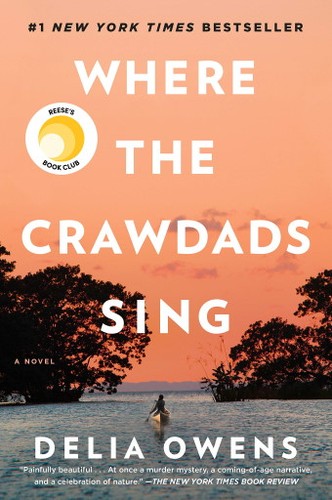
Where the Crawdads Sing by Delia Owens is a 2018 contemporary fiction book about solitude and self-reliance, nature as home, class and prejudice. The marsh is the book's true protagonist. Owens's scientific background produces a setting with unusual biological specificity — the ecosystem functions as both landscape and moral framework.
Summary
Where the Crawdads Sing tells two stories in alternating time frames. In the 1950s and 1960s, Kya Clark is growing up alone in the North Carolina marsh after her family abandons her one by one, leaving a child to feed herself and survive in a landscape most people in the nearby town regard as worthless and wild. In 1969, a local man is found dead, and the investigation circles back to Kya, now known as the Marsh Girl — an adult woman who has lived in isolation so long that she has become a kind of myth.
The book's great strength is the marsh itself. Owens is a wildlife scientist, and the North Carolina coastal wetland in these pages is rendered with the specificity of someone who actually knows it: the species, the light, the seasons, the particular texture of a place that is simultaneously beautiful and capable of killing you. Kya's relationship to the marsh — she becomes a naturalist by necessity, then by vocation — gives the book its most convincing and affecting material. When the novel is about nature, it is genuinely good.
The human drama is more conventional. The romance plots that run through Kya's story follow predictable shapes — the boy who seems good and isn't, the man who seems right and might be — and the courtroom thriller in the 1969 frame relies on a twist that divides readers sharply. Owens is sentimental about her protagonist in ways that can feel like special pleading; the deck is stacked against Kya's accusers from early in the book. The emotional catharsis is real, but it is delivered by means the more critically-minded reader will notice.
The novel sold over fifteen million copies and spent years on bestseller lists. That scale of readership is not an accident: it delivers on every promise it makes. The marsh is immersive, Kya is sympathetic, and the ending is emotionally complete. What it doesn't quite deliver is the complexity it hints at — the nature-justice parallel runs closer to parable than to novel. Readers who meet it on its own terms will love it; readers who need moral ambiguity from their fiction will feel its limits.
Talk to Where the Crawdads Sing like its author wrote you back.
Get the ideas that fit your life — not generic summaries.
- Chat with the book
- Audiobook-style main ideas
- Adapts to your life and goals
- Helps you take action
Key takeaways
- 1.
The marsh is the book's true protagonist. Owens's scientific background produces a setting with unusual biological specificity — the ecosystem functions as both landscape and moral framework.
- 2.
Kya's self-sufficiency is the novel's central argument: that solitude, under the right conditions, is generative rather than damaging. The novel tests this claim honestly in some places and sentimentally in others.
- 3.
The townspeople's prejudice against Kya is drawn as class-based as much as anything else — the marsh is poor territory, and she is a marsh person.
- 4.
Kya's naturalist work — her illustrated notebooks, her study of firefly mating patterns — is the most quietly radical thing the book does. Science as survival strategy, not career.
- 5.
The two time frames work in parallel but don't fully enrich each other until the final section. The 1969 courtroom drama is less interesting than the survival story it surrounds.
- 6.
The men in Kya's life are drawn with considerable difference in care — some are sketched where they should be rendered.
- 7.
The ending's twist changes the moral valence of the whole novel retroactively. Whether that works depends largely on how you think about justice outside institutional frameworks.
- 8.
Nature in this book is not neutral: it follows its own rules about survival, predation, and the strong consuming the weak. Kya absorbs those rules, and the novel asks what that means for a person.
Discussion questions
Use these on your own, with a book club, or as chat starters in Superbook. Book club version, ready to copy or print →
- 1.
The marsh is described as home for Kya in ways that the town never is. What does the book argue about place and belonging? Is her attachment to the marsh a strength or a limitation?
- 2.
Kya is abandoned multiple times — by each family member in turn, by the men who pursue her, by the community that could have helped her. The novel treats each abandonment differently. Which did you find most affecting, and why?
- 3.
The townspeople's suspicion of Kya is rooted partly in her otherness and partly in class. How does the novel balance those two causes? Does it give equal weight to both?
- 4.
Kya becomes a scientist without institutional training. The novel presents this as natural talent meeting necessity. Is that a romantic notion, or does it feel earned by how Owens writes the actual science?
- 5.
The courtroom sections in 1969 are structured as a conventional thriller. Did you find that structure compatible with the survival story in the earlier sections, or did it feel like a different kind of book?
- 6.
The two men Kya is involved with romantically are drawn very differently in terms of complexity. Is that an artistic choice or a flaw?
- 7.
Owens is a wildlife scientist. Where in the book did that background most visibly affect the quality of the writing?
- 8.
The ending changes how you understand the whole novel. Some readers find it satisfying; others find it a betrayal of what the book seemed to be about. Where do you land?
- 9.
Nature's rules — predation, survival of the fittest, female mimicry in fireflies — are given moral weight in the book. Is the novel arguing that nature provides a better framework for justice than civilization? Do you find that convincing?
- 10.
The book sold over fifteen million copies. What does its readership tell you about what it delivers that readers wanted?
- 11.
Where the Crawdads Sing is sometimes described as a love story and sometimes as a mystery and sometimes as a nature book. Which category fits it best?
- 12.
If Kya had been found guilty at trial, would the book have worked? What would the twist at the end have meant in that scenario?
Themes
Frequently asked questions
-
Is Where the Crawdads Sing worth reading?
Yes, if you want a deeply atmospheric, emotionally absorbing story about a woman who raises herself in a wild landscape. It delivers on its emotional promises. Readers who need moral complexity or resist sentimentality in fiction will find limits, but those limits don't negate what it does well.
-
Is there a movie?
Yes. A film adaptation was released in 2022, directed by Olivia Newman and starring Daisy Edgar-Jones as Kya. It follows the novel's plot closely and has similar strengths and weaknesses.
-
What is the twist at the end of Where the Crawdads Sing?
The novel ends with a suggestion that Kya was responsible for the death she was tried and acquitted for. This reframes the entire book retroactively, including the nature metaphors that run through it.
-
Is the science accurate in the book?
The ecological and biological detail is largely accurate and unusual in its specificity for literary fiction. Owens's background as a wildlife scientist is evident throughout. Some of the behavioral ecology is simplified, but not misleadingly so.
-
Who shouldn't read Where the Crawdads Sing?
Readers who need psychological complexity from their protagonists, or who are put off by novels where the deck is clearly stacked in the heroine's favor. The book is emotionally effective in large part because it is not fully ambiguous about where your sympathies should lie.