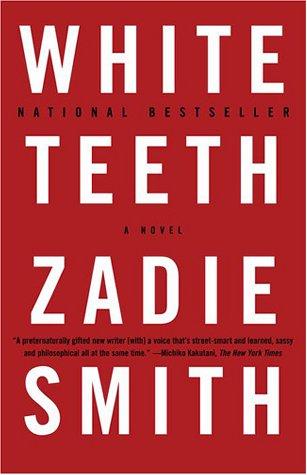
Talk to White Teeth like its author wrote you back.
Get the ideas that fit your life — not generic summaries.
- Chat with the book
- Audiobook-style main ideas
- Adapts to your life and goals
- Helps you take action
White Teeth, in detail
White Teeth begins with two men — Archie Jones, a Englishman of no particular distinction, and Samad Iqbal, a Bangladeshi immigrant and his oldest friend — who met during the last days of the Second World War. The novel then spreads across their families, their children, and their overlapping social worlds in North London over the following decades, arriving at a climax set in 1999 at a biotech company's product launch. It is, among other things, a novel about what it means to be British when you are not from Britain, what it means to be Muslim in secular society, what it means to escape history when history keeps following you.
Smith published White Teeth when she was twenty-four, and the novel has the energy of someone writing faster than they can contain. It is genuinely funny, often brilliantly so — the social comedy of the Iqbal family, of Archie's second wife's Jehovah's Witness family, of the twins Magid and Millat taking almost perfectly opposite paths from the same starting point. The humor is not gentle: Smith is satirizing the comfortable liberal assumptions of multicultural London with real sharpness, and the comedy is the vehicle for something more serious.
The novel's thesis is that historical trauma has a half-life. Samad can't stop returning to his ancestor who fought against the British in 1857; Archie's wartime experience haunts the present; the children and grandchildren of immigrants keep getting pulled back into origins they never experienced. History, White Teeth argues, doesn't stay in the past; it surfaces, mutates, and keeps generating consequences. This is a more interesting argument than the one the novel is usually praised for (multiculturalism is messy but workable), and it's the one that gives the book its real weight.
At 450 pages, this is a long first novel that occasionally shows the seams — Smith's ambition outruns her control in the final third, and the climax is more satirically broad than the personal chapters that precede it. But the vitality of the prose is extraordinary for a debut, and the major characters — Samad in particular — are among the most fully inhabited in British fiction of its era. Comparable to Rushdie's Midnight's Children in scope but warmer in register; different from anything Rooney or Ferrante does but in clear conversation with the same tradition.
The big ideas
- 1.
The half-life of history is the novel's central argument: trauma and origin don't fade away, they resurface in the next generation and the one after that, often in transformed and unrecognizable forms.
- 2.
Samad's decision to send one twin back to Bangladesh to be raised Muslim and keep one in London produces the novel's central irony: the twin meant to preserve tradition becomes secular and Westernized; the twin kept in London becomes a radical Islamist.
- 3.
Smith's multicultural London is not a utopia — it is a site of constant negotiation, misunderstanding, and comedy, and the novel refuses to endorse the comfortable version of 'we're all really the same.'
