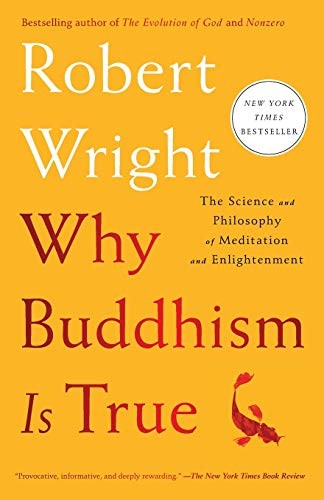
Talk to Why Buddhism Is True like its author wrote you back.
Get the ideas that fit your life — not generic summaries.
- Chat with the book
- Audiobook-style main ideas
- Adapts to your life and goals
- Helps you take action
What it argues
Why Buddhism Is True is Robert Wright's argument that modern evolutionary psychology and neuroscience provide independent confirmation for core Buddhist claims about the mind, suffering, and the nature of the self. Wright is careful to specify what he means by "true": not the cosmological or metaphysical claims about rebirth and karma, but the psychological core — the diagnosis of the human mind as fundamentally prone to suffering, delusion, and craving, and the prescription of meditation as a practical remedy.
The evolutionary argument is the book's scaffold. Natural selection didn't design us to be happy; it designed us to survive and reproduce. This means our minds are calibrated to experience certain kinds of suffering — anxiety, envy, craving, tribal hostility — as motivators toward fitness-enhancing behavior. The pleasures that evolution built are typically fleeting and followed by more craving; the satisfactions that actually feel meaningful are often blocked by the same system. Buddhism's diagnosis of suffering as rooted in craving and delusion, Wright argues, is what evolutionary psychology independently predicts we would find.
What it gets right
- 1.
Natural selection designed the human mind not for happiness but for survival and reproduction — Buddhism's diagnosis of suffering is exactly what evolutionary theory predicts.
- 2.
The hedonic treadmill — craving, brief satisfaction, more craving — is an evolutionary feature, not a bug, and meditation is a way of stepping off it.
- 3.
Mindfulness practice can decouple emotional reactions from stimuli, reducing the automatic craving-and-aversion cycle that drives much human suffering.
What it covers
Who wrote it
Robert Wright is an American journalist, author, and visiting professor at Union Theological Seminary in New York. He is the author of The Moral Animal (1994), Nonzero (2000), and The Evolution of God (2009), all of which apply evolutionary theory to questions of ethics, history, and religion. Why Buddhism Is True draws on his own experience with secular mindfulness practice and his extensive reading in evolutionary psychology and neuroscience. He writes at Nonzero Newsletter and teaches a popular online course on Buddhism and modern psychology.
