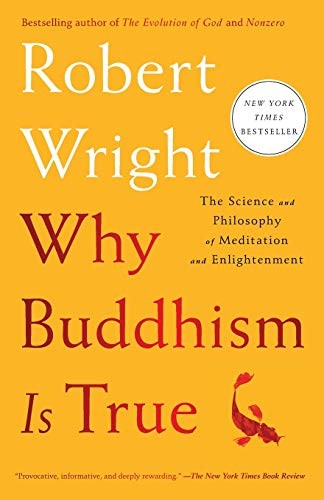
Talk to Why Buddhism Is True like its author wrote you back.
Get the ideas that fit your life — not generic summaries.
- Chat with the book
- Audiobook-style main ideas
- Adapts to your life and goals
- Helps you take action
Why Buddhism Is True, in detail
Why Buddhism Is True is Robert Wright's argument that modern evolutionary psychology and neuroscience provide independent confirmation for core Buddhist claims about the mind, suffering, and the nature of the self. Wright is careful to specify what he means by "true": not the cosmological or metaphysical claims about rebirth and karma, but the psychological core — the diagnosis of the human mind as fundamentally prone to suffering, delusion, and craving, and the prescription of meditation as a practical remedy.
The evolutionary argument is the book's scaffold. Natural selection didn't design us to be happy; it designed us to survive and reproduce. This means our minds are calibrated to experience certain kinds of suffering — anxiety, envy, craving, tribal hostility — as motivators toward fitness-enhancing behavior. The pleasures that evolution built are typically fleeting and followed by more craving; the satisfactions that actually feel meaningful are often blocked by the same system. Buddhism's diagnosis of suffering as rooted in craving and delusion, Wright argues, is what evolutionary psychology independently predicts we would find.
The neuroscience of mindfulness adds empirical weight. Research on meditators shows that practice can decouple emotional reactions from stimuli — reducing the automatic craving and aversion cycle — and alter the default mode network associated with self-referential rumination. Not-self (anatta), the Buddhist claim that the unified self is an illusion, finds a parallel in neuroscience's picture of the brain as a coalition of competing modules with no single executive.
Wright is honest about the limits of his argument. He is not a Buddhist and does not practice in a traditional framework. The book is explicitly the argument of an outsider assessing the evidence, not a practitioner's testimony. The meditation techniques he describes are drawn from secular mindfulness tradition as much as from classical Buddhism. And the "truth" he defends is a carefully bounded version that brackets the metaphysical claims the tradition also makes. Whether that selective endorsement is honest or evasive is a question the book explicitly raises and does not entirely resolve.
The big ideas
- 1.
Natural selection designed the human mind not for happiness but for survival and reproduction — Buddhism's diagnosis of suffering is exactly what evolutionary theory predicts.
- 2.
The hedonic treadmill — craving, brief satisfaction, more craving — is an evolutionary feature, not a bug, and meditation is a way of stepping off it.
- 3.
Mindfulness practice can decouple emotional reactions from stimuli, reducing the automatic craving-and-aversion cycle that drives much human suffering.
