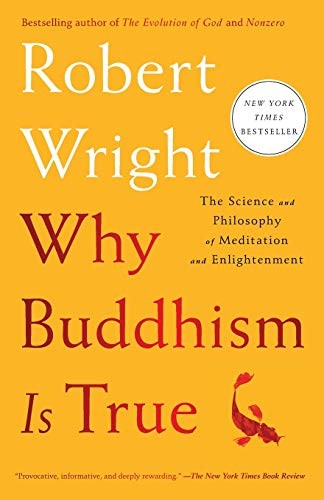
Why Buddhism Is True by Robert Wright is a 2017 religion & spirituality book about buddhism, evolutionary psychology, mindfulness. Natural selection designed the human mind not for happiness but for survival and reproduction — Buddhism's diagnosis of suffering is exactly what evolutionary theory predicts.
Summary
Why Buddhism Is True is Robert Wright's argument that modern evolutionary psychology and neuroscience provide independent confirmation for core Buddhist claims about the mind, suffering, and the nature of the self. Wright is careful to specify what he means by "true": not the cosmological or metaphysical claims about rebirth and karma, but the psychological core — the diagnosis of the human mind as fundamentally prone to suffering, delusion, and craving, and the prescription of meditation as a practical remedy.
The evolutionary argument is the book's scaffold. Natural selection didn't design us to be happy; it designed us to survive and reproduce. This means our minds are calibrated to experience certain kinds of suffering — anxiety, envy, craving, tribal hostility — as motivators toward fitness-enhancing behavior. The pleasures that evolution built are typically fleeting and followed by more craving; the satisfactions that actually feel meaningful are often blocked by the same system. Buddhism's diagnosis of suffering as rooted in craving and delusion, Wright argues, is what evolutionary psychology independently predicts we would find.
The neuroscience of mindfulness adds empirical weight. Research on meditators shows that practice can decouple emotional reactions from stimuli — reducing the automatic craving and aversion cycle — and alter the default mode network associated with self-referential rumination. Not-self (anatta), the Buddhist claim that the unified self is an illusion, finds a parallel in neuroscience's picture of the brain as a coalition of competing modules with no single executive.
Wright is honest about the limits of his argument. He is not a Buddhist and does not practice in a traditional framework. The book is explicitly the argument of an outsider assessing the evidence, not a practitioner's testimony. The meditation techniques he describes are drawn from secular mindfulness tradition as much as from classical Buddhism. And the "truth" he defends is a carefully bounded version that brackets the metaphysical claims the tradition also makes. Whether that selective endorsement is honest or evasive is a question the book explicitly raises and does not entirely resolve.
Talk to Why Buddhism Is True like its author wrote you back.
Get the ideas that fit your life — not generic summaries.
- Chat with the book
- Audiobook-style main ideas
- Adapts to your life and goals
- Helps you take action
Key takeaways
- 1.
Natural selection designed the human mind not for happiness but for survival and reproduction — Buddhism's diagnosis of suffering is exactly what evolutionary theory predicts.
- 2.
The hedonic treadmill — craving, brief satisfaction, more craving — is an evolutionary feature, not a bug, and meditation is a way of stepping off it.
- 3.
Mindfulness practice can decouple emotional reactions from stimuli, reducing the automatic craving-and-aversion cycle that drives much human suffering.
- 4.
The Buddhist doctrine of not-self (anatta) finds parallels in neuroscience: the unified self may be a useful fiction constructed by a brain with no single executive.
- 5.
Feelings evolved as signals about fitness-relevant situations — their evolutionary function is not to accurately represent reality but to motivate behavior.
- 6.
The 'modularity of mind' — the brain as a coalition of competing subsystems — undermines the intuition of a unified, coherent self in control of its actions.
- 7.
Mindfulness meditation changes not just how you feel in the moment but the underlying neural infrastructure of perception, emotion, and self-referential thought.
- 8.
The core Buddhist claim that Wright defends is narrow: suffering is real, craving is its root, and meditation can help. The metaphysical superstructure can be set aside.
Discussion questions
Use these on your own, with a book club, or as chat starters in Superbook. Book club version, ready to copy or print →
- 1.
Wright argues that natural selection designed us to suffer in specific ways. Does understanding the evolutionary origins of your unhappiness change anything about how you relate to it?
- 2.
The hedonic treadmill describes how pleasure briefly satisfies craving before generating more craving. Where in your own life do you see this pattern most clearly?
- 3.
Wright makes a distinction between the psychological core of Buddhism (which he defends) and its metaphysical claims (which he brackets). Is that distinction philosophically defensible, or does it gut the religion of its content?
- 4.
The book argues that feelings are evolutionary signals, not accurate guides to reality or wellbeing. Which of your most reliable feelings do you think is most misleading?
- 5.
Neuroscience suggests the unified self is a construction rather than a fact. Does that finding seem liberating or disorienting to you?
- 6.
Wright draws heavily on secular mindfulness research. Does the secular framing of mindfulness strip something important from the Buddhist original, or make it more accessible and honest?
- 7.
If suffering is the inevitable product of evolutionary design, why would meditation — itself a product of evolution — be able to overcome it?
- 8.
Wright admits he is not a committed Buddhist practitioner. Does that undermine or strengthen his argument? Is the outsider's perspective a handicap or an advantage here?
- 9.
The evolutionary argument for Buddhist practice is indirect — it confirms the diagnosis without confirming the metaphysics. Is that enough to motivate practice?
- 10.
What would change in how you practice mindfulness (if you do) if you took seriously the idea that your feelings evolved to mislead you toward fitness rather than truth?
- 11.
The book's subtitle is 'The Science and Philosophy of Meditation and Enlightenment.' Does it deliver on the enlightenment part, or does it stop short?
Themes
Frequently asked questions
-
What is Why Buddhism Is True actually arguing?
That evolutionary psychology independently confirms Buddhism's core psychological diagnosis: the human mind is calibrated for suffering, craving is its root, and meditation practice can address this at the neural level. Wright explicitly brackets Buddhism's metaphysical claims about rebirth and karma.
-
Do I need to meditate to benefit from this book?
No. The book is as much an argument as a practice manual. But Wright makes the case that the insights only become fully real when tested in practice, so he recommends trying meditation alongside reading.
-
How does this compare to Sam Harris's Waking Up?
Both are secular defenses of meditation by non-traditional practitioners. Wright is more focused on evolutionary psychology as confirmatory evidence; Harris is more focused on consciousness and phenomenology. Both bracket Buddhist metaphysics while endorsing the core contemplative practices.
-
Is this a book for people who are already Buddhist?
It is written primarily for skeptics and secular readers. Traditional Buddhists may find the selective defense of only the psychological core unsatisfying. The book's real audience is people curious about meditation and mindfulness who want an evidence-based case for why it might work.
-
What is the hedonic treadmill?
The tendency for pleasures to briefly satisfy a craving before generating new cravings of equal or greater intensity, keeping the mind perpetually dissatisfied. It is a feature of evolutionary design — satisfaction would reduce motivation — and Buddhism's critique of craving is a critique of this same dynamic.
Similar books

What the Buddha Taught
Walpola Rahula

The Dhammapada
Anonymous
Waking Up: A Guide to Spirituality Without Religion
Sam Harris
The Heart of the Buddha's Teaching
Thich Nhat Hanh
