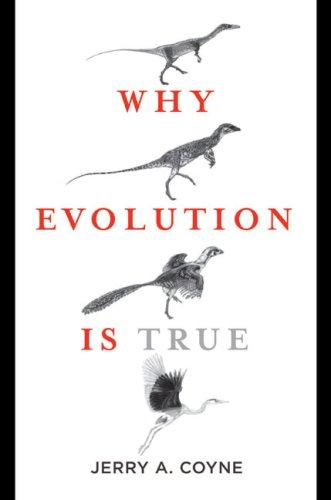
Talk to Why Evolution Is True like its author wrote you back.
Get the ideas that fit your life — not generic summaries.
- Chat with the book
- Audiobook-style main ideas
- Adapts to your life and goals
- Helps you take action
Why Evolution Is True, in detail
Why Evolution Is True is evolutionary geneticist Jerry Coyne's systematic case for evolution, written for readers who want a rigorous but accessible treatment of the evidence. Coyne, a professor at the University of Chicago, approaches the question as a scientist rather than a polemicist: he lays out what evolution predicts, examines whether the evidence matches, and considers what would count as falsification. The book is organized by type of evidence — the fossil record, vestigial organs, biogeography, natural selection in action, sexual selection, and the origin of species.
The fossil record chapters are careful about what the evidence shows and where the gaps are. Coyne is direct: if evolution is true, we expect transitional forms connecting major groups, and we find them. Tiktaalik, the fish-tetrapod transitional form discovered in 2004, gets detailed treatment. So does the horse series and the whale evolution sequence — the accumulation of fossil evidence documenting the transition from land mammals to fully aquatic whales, complete with intermediate forms showing functional legs.
The molecular genetics section draws on comparative genomics to build the case for common descent. Endogenous retroviruses — viral sequences integrated into the genomes of multiple related species at the same chromosomal location — provide particularly compelling evidence. Like pseudogenes, they make sense as shared evolutionary history and are very difficult to explain otherwise.
Coyne is also frank about the limits of current knowledge. The origin of life is not explained by evolution — it is a separate problem. The mechanisms behind some macroevolutionary patterns remain debated. And speciation, the process by which one lineage becomes two reproductively isolated ones, is understood in principle but the details are still actively researched. This intellectual honesty makes the book more credible, not less. Why Evolution Is True stands alongside The Greatest Show on Earth as one of the two best popular treatments of the evidentiary case for evolution written in the 2000s.
The big ideas
- 1.
Evolution is as well-supported as any theory in science. The converging evidence from genetics, the fossil record, biogeography, comparative anatomy, and direct observation leaves no serious scientific alternative.
- 2.
The whale fossil sequence — showing fully land-dwelling ancestors transitioning through forms with functional legs to fully aquatic animals — is one of the most complete and compelling transitional series in the record.
- 3.
Tiktaalik, discovered in 2004 in rocks of the predicted age, shows a fish with proto-limb structures. It was found where and when evolutionary theory predicted a fish-tetrapod transition would be.
