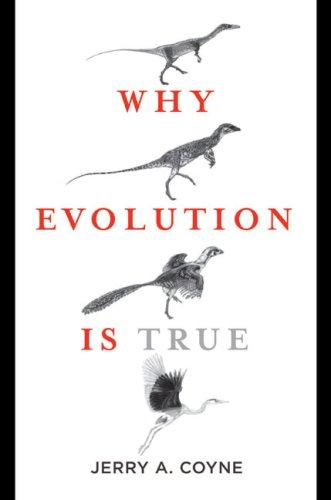
Why Evolution Is True by Jerry A. Coyne is a 2009 science book about evolution, natural selection, evidence. Evolution is as well-supported as any theory in science. The converging evidence from genetics, the fossil record, biogeography, comparative anatomy, and direct observation leaves no serious scientific alternative.
Summary
Why Evolution Is True is evolutionary geneticist Jerry Coyne's systematic case for evolution, written for readers who want a rigorous but accessible treatment of the evidence. Coyne, a professor at the University of Chicago, approaches the question as a scientist rather than a polemicist: he lays out what evolution predicts, examines whether the evidence matches, and considers what would count as falsification. The book is organized by type of evidence — the fossil record, vestigial organs, biogeography, natural selection in action, sexual selection, and the origin of species.
The fossil record chapters are careful about what the evidence shows and where the gaps are. Coyne is direct: if evolution is true, we expect transitional forms connecting major groups, and we find them. Tiktaalik, the fish-tetrapod transitional form discovered in 2004, gets detailed treatment. So does the horse series and the whale evolution sequence — the accumulation of fossil evidence documenting the transition from land mammals to fully aquatic whales, complete with intermediate forms showing functional legs.
The molecular genetics section draws on comparative genomics to build the case for common descent. Endogenous retroviruses — viral sequences integrated into the genomes of multiple related species at the same chromosomal location — provide particularly compelling evidence. Like pseudogenes, they make sense as shared evolutionary history and are very difficult to explain otherwise.
Coyne is also frank about the limits of current knowledge. The origin of life is not explained by evolution — it is a separate problem. The mechanisms behind some macroevolutionary patterns remain debated. And speciation, the process by which one lineage becomes two reproductively isolated ones, is understood in principle but the details are still actively researched. This intellectual honesty makes the book more credible, not less. Why Evolution Is True stands alongside The Greatest Show on Earth as one of the two best popular treatments of the evidentiary case for evolution written in the 2000s.
Talk to Why Evolution Is True like its author wrote you back.
Get the ideas that fit your life — not generic summaries.
- Chat with the book
- Audiobook-style main ideas
- Adapts to your life and goals
- Helps you take action
Key takeaways
- 1.
Evolution is as well-supported as any theory in science. The converging evidence from genetics, the fossil record, biogeography, comparative anatomy, and direct observation leaves no serious scientific alternative.
- 2.
The whale fossil sequence — showing fully land-dwelling ancestors transitioning through forms with functional legs to fully aquatic animals — is one of the most complete and compelling transitional series in the record.
- 3.
Tiktaalik, discovered in 2004 in rocks of the predicted age, shows a fish with proto-limb structures. It was found where and when evolutionary theory predicted a fish-tetrapod transition would be.
- 4.
Endogenous retroviruses — viral DNA integrated into multiple species' genomes at the same chromosomal location — are compelling evidence for common descent. They make sense as shared evolutionary history and no other explanation fits.
- 5.
Sexual selection explains many traits that would otherwise seem maladaptive: the peacock's tail, deer antlers, and bright coloration in male birds reduce survival but increase reproductive success in environments where mate choice operates.
- 6.
Speciation — the splitting of one lineage into two reproductively isolated ones — has been directly observed in the laboratory and the field. It is not a theoretical prediction but a documented process.
- 7.
Vestigial structures, atavisms (rare re-expressions of ancestral traits), and poorly designed anatomy — including the backward-wiring of the human retina — are exactly what evolution predicts and what intelligent design cannot plausibly accommodate.
- 8.
Natural selection in action is directly observable: antibiotic resistance, pesticide resistance, industrial melanism in moths, and beak evolution in Galápagos finches are all documented in real time.
Discussion questions
Use these on your own, with a book club, or as chat starters in Superbook. Book club version, ready to copy or print →
- 1.
Coyne says evolution is falsifiable — it could be disproven by finding fossils in the wrong stratigraphic layer. What other evidence would count as falsification to you?
- 2.
The whale fossil sequence is unusually complete. Does the completeness of that particular sequence change how you think about the gaps in other parts of the fossil record?
- 3.
Endogenous retroviruses in the same chromosomal positions across related species are one of the strongest genomic arguments for common descent. Why do you think this argument is less commonly discussed than the fossil record?
- 4.
Coyne distinguishes evolution from the origin of life. Why does that distinction matter, and do you think the distinction is commonly understood in public debates about evolution?
- 5.
Sexual selection produces traits — like the peacock's tail — that reduce individual survival but increase reproductive success. What does that imply about the relationship between 'fitness' and what most people mean by 'better'?
- 6.
Atavisms — the occasional re-expression of ancestral traits like extra toes in horses or legs in dolphins — appear rarely but predictably. What do they tell us about how genetic information is maintained and suppressed over evolutionary time?
- 7.
Coyne acknowledges ongoing debates in evolutionary biology. Does uncertainty about some mechanisms undermine confidence in the core claim, or is that uncertainty just science working normally?
- 8.
The backward wiring of the vertebrate retina is a functional but suboptimal solution. If a designer made it, what would that imply about the designer? How should we evaluate that kind of argument?
- 9.
Direct observation of speciation in the laboratory seems like it should be decisive. Why do you think it doesn't end public debates about evolution?
- 10.
Industrial melanism in moths was used for decades as a textbook example of natural selection, then was challenged on methodological grounds, then was rehabilitated by better studies. What does that episode tell you about how science handles contested evidence?
- 11.
Coyne is passionate about evolution but careful about evidence. Is it possible to be both an advocate and a rigorous evaluator of the same claim, or does advocacy inevitably compromise rigor?
- 12.
Having read the evidence, how would you explain to someone who doubted evolution why the scientific consensus is so strong? Which piece of evidence would you lead with?
Themes
Frequently asked questions
-
Is Why Evolution Is True worth reading?
Yes, especially if you want a carefully argued, evidence-based treatment by an active evolutionary geneticist. Coyne is more precise about what the evidence shows and where gaps exist than most popular accounts. The chapters on molecular evidence and speciation are particularly strong.
-
How does this compare to The Greatest Show on Earth by Dawkins?
Both make the evidentiary case for evolution and were published the same year. Coyne is slightly more restrained in tone and more technically detailed; Dawkins is more engaging as prose. Coyne's treatment of speciation is deeper; Dawkins's fossil record chapters are more vivid. Both are worth reading.
-
Does the book address creationism and intelligent design directly?
Yes, throughout. Coyne systematically shows why the evidence is inconsistent with intelligent design and what specific predictions of creationism the evidence falsifies. The treatment is even-handed in presenting the claims before refuting them.
-
What is the most compelling evidence Coyne presents?
The molecular genetics evidence — particularly endogenous retroviruses and pseudogenes shared across related species — is the hardest to dispute. The fossil transitions for whales and tetrapods are also unusually complete and well-documented.
-
Who should read Why Evolution Is True?
Anyone who wants the full scientific case for evolution presented by a working evolutionary biologist. It is well-suited to readers who are genuinely uncertain about evolution, or who know evolution is true but want to understand why scientists are so confident.