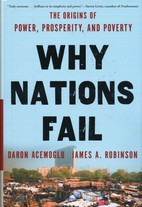
Talk to Why Nations Fail: The Origins of Power, Prosperity, and Poverty like its author wrote you back.
Get the ideas that fit your life — not generic summaries.
- Chat with the book
- Audiobook-style main ideas
- Adapts to your life and goals
- Helps you take action
What it argues
Daron Acemoglu and James Robinson argue that the fundamental difference between rich and poor countries is not geography, culture, or bad luck. It is institutions — specifically, whether a country's political and economic institutions are inclusive or extractive. Inclusive institutions create broad incentives, protect property rights, enforce contracts, and distribute power widely enough that no single group can permanently exploit everyone else. Extractive institutions concentrate power and wealth in the hands of a narrow elite that designs the rules to protect its own position at everyone else's expense.
The book's central tension is that extractive institutions can generate short-run growth — the Soviet Union industrialized rapidly, colonial plantations were highly productive — but they fail to sustain innovation because innovation threatens existing elites. Acemoglu and Robinson call this the "fear of creative destruction." An extractive elite will block new technology, new competitors, and new political arrangements precisely because these would erode its control. This is why extractive societies eventually stagnate even after periods of apparent success.
What it gets right
- 1.
The central determinant of national prosperity is whether political and economic institutions are inclusive or extractive — not geography, culture, or religion.
- 2.
Extractive institutions concentrate power and wealth in a narrow elite. They can produce short-term growth but systematically block the creative destruction that drives innovation.
- 3.
Inclusive institutions protect property rights and create broad incentives to invest, innovate, and participate in economic life — but they require a pluralistic distribution of political power to sustain themselves.
What it covers
Who wrote it
Daron Acemoglu is an economist at MIT and one of the most cited social scientists in the world. James A. Robinson is a political scientist at the University of Chicago. Together they have collaborated on research into the long-run determinants of prosperity and political development for over two decades. Acemoglu won the Nobel Prize in Economics in 2024, in part for work that forms the empirical core of this book. Their follow-up, The Narrow Corridor, extends the institutional argument to the specific problem of liberty under state power.
