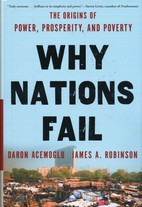
Talk to Why Nations Fail: The Origins of Power, Prosperity, and Poverty like its author wrote you back.
Get the ideas that fit your life — not generic summaries.
- Chat with the book
- Audiobook-style main ideas
- Adapts to your life and goals
- Helps you take action
Why Nations Fail: The Origins of Power, Prosperity, and Poverty, in detail
Daron Acemoglu and James Robinson argue that the fundamental difference between rich and poor countries is not geography, culture, or bad luck. It is institutions — specifically, whether a country's political and economic institutions are inclusive or extractive. Inclusive institutions create broad incentives, protect property rights, enforce contracts, and distribute power widely enough that no single group can permanently exploit everyone else. Extractive institutions concentrate power and wealth in the hands of a narrow elite that designs the rules to protect its own position at everyone else's expense.
The book's central tension is that extractive institutions can generate short-run growth — the Soviet Union industrialized rapidly, colonial plantations were highly productive — but they fail to sustain innovation because innovation threatens existing elites. Acemoglu and Robinson call this the "fear of creative destruction." An extractive elite will block new technology, new competitors, and new political arrangements precisely because these would erode its control. This is why extractive societies eventually stagnate even after periods of apparent success.
The argument is illustrated with a sprawling set of case studies. Nogales, Arizona and Nogales, Sonora share the same geography, climate, and culture but divergent prosperity — the difference is the border and the institutions on either side. Colonial powers systematically installed extractive institutions where disease environments made white settlement impractical, and inclusive ones where settlers could thrive. These institutional choices compounded over centuries through what the authors call "critical junctures" — moments like the Black Death, the Atlantic trade, and the Industrial Revolution where small institutional differences produced large divergent outcomes.
The policy implications are sobering. If institutions are what matter, then foreign aid, economic advice, and technical assistance can't reliably help — they get filtered through existing institutional arrangements. The book is stronger as a diagnosis than as a guide to change, and critics have noted that the case studies are sometimes cherry-picked to fit the thesis. But as a framework for understanding why some countries stay poor despite abundant resources, it remains one of the most compelling and rigorously argued accounts available.
The big ideas
- 1.
The central determinant of national prosperity is whether political and economic institutions are inclusive or extractive — not geography, culture, or religion.
- 2.
Extractive institutions concentrate power and wealth in a narrow elite. They can produce short-term growth but systematically block the creative destruction that drives innovation.
- 3.
Inclusive institutions protect property rights and create broad incentives to invest, innovate, and participate in economic life — but they require a pluralistic distribution of political power to sustain themselves.
