Why Nations Fail: The Origins of Power, Prosperity, and Poverty by Daron Acemoglu and James A. Robinson is a 2012 economics book about institutions, political economy, development. The central determinant of national prosperity is whether political and economic institutions are inclusive or extractive — not geography, culture, or religion.
Summary
Daron Acemoglu and James Robinson argue that the fundamental difference between rich and poor countries is not geography, culture, or bad luck. It is institutions — specifically, whether a country's political and economic institutions are inclusive or extractive. Inclusive institutions create broad incentives, protect property rights, enforce contracts, and distribute power widely enough that no single group can permanently exploit everyone else. Extractive institutions concentrate power and wealth in the hands of a narrow elite that designs the rules to protect its own position at everyone else's expense.
The book's central tension is that extractive institutions can generate short-run growth — the Soviet Union industrialized rapidly, colonial plantations were highly productive — but they fail to sustain innovation because innovation threatens existing elites. Acemoglu and Robinson call this the "fear of creative destruction." An extractive elite will block new technology, new competitors, and new political arrangements precisely because these would erode its control. This is why extractive societies eventually stagnate even after periods of apparent success.
The argument is illustrated with a sprawling set of case studies. Nogales, Arizona and Nogales, Sonora share the same geography, climate, and culture but divergent prosperity — the difference is the border and the institutions on either side. Colonial powers systematically installed extractive institutions where disease environments made white settlement impractical, and inclusive ones where settlers could thrive. These institutional choices compounded over centuries through what the authors call "critical junctures" — moments like the Black Death, the Atlantic trade, and the Industrial Revolution where small institutional differences produced large divergent outcomes.
The policy implications are sobering. If institutions are what matter, then foreign aid, economic advice, and technical assistance can't reliably help — they get filtered through existing institutional arrangements. The book is stronger as a diagnosis than as a guide to change, and critics have noted that the case studies are sometimes cherry-picked to fit the thesis. But as a framework for understanding why some countries stay poor despite abundant resources, it remains one of the most compelling and rigorously argued accounts available.
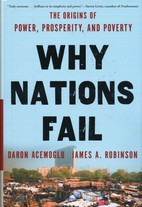
Talk to Why Nations Fail: The Origins of Power, Prosperity, and Poverty like its author wrote you back.
Get the ideas that fit your life — not generic summaries.
- Chat with the book
- Audiobook-style main ideas
- Adapts to your life and goals
- Helps you take action
Key takeaways
- 1.
The central determinant of national prosperity is whether political and economic institutions are inclusive or extractive — not geography, culture, or religion.
- 2.
Extractive institutions concentrate power and wealth in a narrow elite. They can produce short-term growth but systematically block the creative destruction that drives innovation.
- 3.
Inclusive institutions protect property rights and create broad incentives to invest, innovate, and participate in economic life — but they require a pluralistic distribution of political power to sustain themselves.
- 4.
History compounds. Small institutional differences at critical junctures — the Black Death, the Atlantic trade, industrialization — produce large divergent outcomes that persist for centuries.
- 5.
Colonial powers deliberately installed extractive institutions in tropical regions where settlers couldn't live, and more inclusive institutions where they could. The economic consequences of that choice persist today.
- 6.
The 'fear of creative destruction' explains why extractive elites block technology and competition: both threaten existing power arrangements more than they threaten economic output.
- 7.
The vicious and virtuous cycles of institutions are self-reinforcing. Extractive institutions create incentives to capture the state; inclusive ones create incentives to maintain the rules.
- 8.
Foreign aid and technical assistance rarely change outcomes because they are absorbed by the institutions they pass through. Durable change requires institutional change, which requires political change.
- 9.
Political and economic institutions co-evolve: you cannot sustain inclusive economic institutions indefinitely without inclusive political institutions, and vice versa.
Discussion questions
Use these on your own, with a book club, or as chat starters in Superbook. Book club version, ready to copy or print →
- 1.
The authors argue that geography and culture don't explain prosperity, but institutions do. Does that feel right to you? What evidence in your own experience pushes back against it?
- 2.
Can you think of a country that has maintained extractive political institutions while building genuinely inclusive economic ones? Does it contradict the argument?
- 3.
The Nogales example is the book's most striking. What other border pairs — physical, historical, or political — show similar divergence?
- 4.
Acemoglu and Robinson say foreign aid mostly fails because it is absorbed by extractive institutions. If that's right, what should rich countries do instead?
- 5.
What was the most recent critical juncture in your country's history? Did it reinforce or weaken inclusive institutions?
- 6.
The book says short-run growth under extractive systems is real but unsustainable. Does China fit this model, and how would you know when the stagnation arrives?
- 7.
How do you distinguish a country building inclusive institutions from one whose elite is performing inclusion while protecting its position?
- 8.
The authors are historians by method. How much confidence do case studies give you in a causal claim of this scope?
- 9.
They argue that the Industrial Revolution succeeded in Britain because of prior institutional change. Is that persuasive, or does it explain too much with hindsight?
- 10.
What would it take, concretely, to break an entrenched extractive system? The book identifies critical junctures but doesn't fully explain how to create them.
- 11.
Is there a risk that the inclusive/extractive framing naturalizes Western political arrangements as the global ideal? How might that distort the analysis?
- 12.
Which institution in your own country most resembles an extractive arrangement, and who are the beneficiaries?
Themes
Frequently asked questions
-
Is Why Nations Fail worth reading?
Yes, if you want a single framework for understanding global inequality that goes deeper than geography or culture. It is long and the case studies are dense, but the core argument is genuinely illuminating. Read the first three chapters before deciding whether to continue.
-
How long does it take to read Why Nations Fail?
Around nine to ten hours at average reading pace. At nearly 500 pages, it is not a quick read. The argument is fully stated by about a third of the way through; the rest is case studies that test and extend it.
-
What is the central idea of Why Nations Fail?
That inclusive institutions — ones that protect property rights, distribute power broadly, and reward innovation — explain prosperity, while extractive institutions explain poverty. Geography and culture are secondary to political arrangements.
-
Who should read Why Nations Fail?
Anyone interested in development economics, political economy, or the long arc of history. It's also valuable for anyone working in international development or policy who wants a critical framework for thinking about why interventions so often fail.
-
What are the main criticisms of the book?
Critics argue that the case studies are selected to fit the thesis, that the inclusive/extractive distinction is sometimes circular, and that the book underweights culture and ideas. Jeffrey Sachs and others have questioned whether geography is really as irrelevant as claimed.
Similar books
Sapiens: A Brief History of Humankind
Yuval Noah Harari

Guns, Germs, and Steel
Jared Diamond

21 Lessons for the 21st Century
Yuval Noah Harari

Homo Deus: A Brief History of Tomorrow
Yuval Noah Harari
