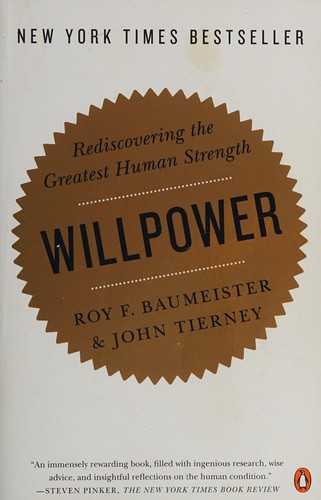
Talk to Willpower: Rediscovering the Greatest Human Strength like its author wrote you back.
Get the ideas that fit your life — not generic summaries.
- Chat with the book
- Audiobook-style main ideas
- Adapts to your life and goals
- Helps you take action
Willpower: Rediscovering the Greatest Human Strength, in detail
Willpower is social psychologist Roy Baumeister's synthesis of decades of laboratory research on self-control, translated into practical guidance by science journalist John Tierney. The book's central claim — that willpower is a limited resource that depletes with use, just as a muscle fatigues — was one of the most discussed and debated ideas in psychology in the 2010s. Whether or not the strict glucose-depletion mechanism holds up to replication, the practical lesson stands: self-control is finite and its management matters.
Baumeister's original ego depletion experiments showed that people who exercised self-control on one task subsequently performed worse on unrelated self-control tasks. This finding has spawned an enormous research literature and significant replication controversy. The book presents the original research charitably, with Tierney acknowledging ongoing debate but arguing that the practical implications remain useful regardless of the precise underlying mechanism.
The practical chapters are the book's strongest. Decision fatigue — the finding that the quality of decisions declines over time spent making them — explains why judges grant fewer paroles in the afternoon, why shoppers make worse choices late in a shopping trip, and why you order dessert at the end of a long dinner rather than the beginning. The takeaway is to schedule important decisions early and reduce trivial decisions wherever possible.
The final section covers strategies for husbanding willpower: making commitments in advance, building bright-line rules that eliminate in-the-moment deliberation, using implementation intentions, and monitoring behavior through tracking. The book is honest that willpower research is harder to apply than it is to understand — most people know they have limited self-control but don't build their lives to reflect that knowledge.
The big ideas
- 1.
Willpower appears to be a limited resource. Using it for one task reduces your capacity for self-control on the next, a phenomenon Baumeister calls ego depletion.
- 2.
Decision fatigue is real: the quality of decisions degrades over long decision-making sessions. Schedule high-stakes decisions for the beginning of the day or after rest.
- 3.
Glucose levels influence willpower. This doesn't mean eating candy restores it, but sustained low blood sugar correlates with worse self-control.
