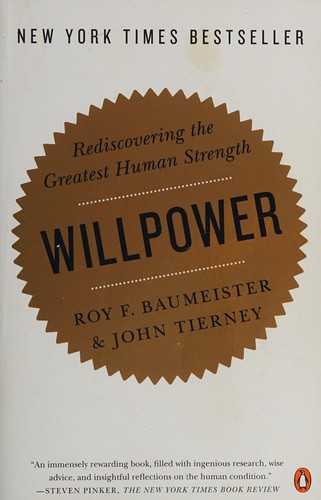
Willpower: Rediscovering the Greatest Human Strength by Roy Baumeister and John Tierney is a 2011 psychology book about willpower, self-control, decision making. Willpower appears to be a limited resource. Using it for one task reduces your capacity for self-control on the next, a phenomenon Baumeister calls ego depletion.
Summary
Willpower is social psychologist Roy Baumeister's synthesis of decades of laboratory research on self-control, translated into practical guidance by science journalist John Tierney. The book's central claim — that willpower is a limited resource that depletes with use, just as a muscle fatigues — was one of the most discussed and debated ideas in psychology in the 2010s. Whether or not the strict glucose-depletion mechanism holds up to replication, the practical lesson stands: self-control is finite and its management matters.
Baumeister's original ego depletion experiments showed that people who exercised self-control on one task subsequently performed worse on unrelated self-control tasks. This finding has spawned an enormous research literature and significant replication controversy. The book presents the original research charitably, with Tierney acknowledging ongoing debate but arguing that the practical implications remain useful regardless of the precise underlying mechanism.
The practical chapters are the book's strongest. Decision fatigue — the finding that the quality of decisions declines over time spent making them — explains why judges grant fewer paroles in the afternoon, why shoppers make worse choices late in a shopping trip, and why you order dessert at the end of a long dinner rather than the beginning. The takeaway is to schedule important decisions early and reduce trivial decisions wherever possible.
The final section covers strategies for husbanding willpower: making commitments in advance, building bright-line rules that eliminate in-the-moment deliberation, using implementation intentions, and monitoring behavior through tracking. The book is honest that willpower research is harder to apply than it is to understand — most people know they have limited self-control but don't build their lives to reflect that knowledge.
Talk to Willpower: Rediscovering the Greatest Human Strength like its author wrote you back.
Get the ideas that fit your life — not generic summaries.
- Chat with the book
- Audiobook-style main ideas
- Adapts to your life and goals
- Helps you take action
Key takeaways
- 1.
Willpower appears to be a limited resource. Using it for one task reduces your capacity for self-control on the next, a phenomenon Baumeister calls ego depletion.
- 2.
Decision fatigue is real: the quality of decisions degrades over long decision-making sessions. Schedule high-stakes decisions for the beginning of the day or after rest.
- 3.
Glucose levels influence willpower. This doesn't mean eating candy restores it, but sustained low blood sugar correlates with worse self-control.
- 4.
Bright-line rules eliminate the willpower cost of in-the-moment deliberation. 'I never drink alcohol on weekdays' is easier to maintain than 'I try to drink less.'
- 5.
Implementation intentions — specifying when, where, and how you will act — dramatically increase follow-through compared to vague intentions.
- 6.
Monitoring behavior is a prerequisite for self-regulation. You cannot improve what you don't track, and losing track (especially of food, money, or time) is usually the first step toward losing control.
- 7.
The most effective willpower strategy is to reduce the number of decisions requiring willpower, not to try harder. Automate, delegate, or eliminate decisions wherever possible.
- 8.
Willpower strengthens with use over time, like a muscle — the depletion effect is short-term. Consistent, moderate self-control practice builds capacity.
Discussion questions
Use these on your own, with a book club, or as chat starters in Superbook. Book club version, ready to copy or print →
- 1.
At what point in your day does your self-control typically run lowest? What decisions are you making at that time that might be better moved earlier?
- 2.
Baumeister's research on ego depletion has faced replication challenges. Does that change how you read the book's practical advice? Can advice be useful even if the underlying mechanism is disputed?
- 3.
Where in your life do you rely on willpower in the moment when a bright-line rule or automation could replace it?
- 4.
Think of a decision you make regularly that consistently goes worse when you're tired or hungry. What would it take to make that decision at a different time or make it in advance?
- 5.
The book argues that monitoring is the first step to self-regulation. What in your life are you intentionally not monitoring? Why?
- 6.
Baumeister talks about competing goals — the way having too many active goals depletes willpower faster. What goals are you holding simultaneously that might be undermining each other?
- 7.
Implementation intentions specify exactly when and where you'll act. Pick one habit you've been trying to build. Can you write an implementation intention for it right now?
- 8.
The book covers the failure of New Year's resolutions in some detail. What pattern do you see in your own failed resolutions? Is it the goal, the plan, or the monitoring that breaks down?
- 9.
Where in your life are you most likely to make impulsive decisions you later regret? What conditions precede them?
- 10.
Baumeister argues that people with high self-control don't actually resist temptation more often — they structure their lives to encounter less of it. Who do you know who does this effectively?
- 11.
The book discusses how public commitment increases follow-through. What goal would benefit most from being stated publicly? What stops you from doing that?
- 12.
How does the idea of limited willpower change how you think about judging other people's behavior failures — laziness, overeating, poor financial decisions?
Themes
Frequently asked questions
-
Is Willpower worth reading?
Yes, with the caveat that some of the underlying research — particularly the glucose-depletion mechanism — has faced replication challenges since the book was published. The practical frameworks around decision fatigue, bright-line rules, and implementation intentions remain useful and are grounded in more robust findings.
-
How long does it take to read Willpower?
About five hours at average pace for the roughly 300-page book. The writing is clear and the research anecdotes are engaging. It moves faster than a pure psychology text.
-
What is the main idea of Willpower?
Self-control is a limited resource that depletes with use. The path to better behavior is not trying harder but structuring your life — decisions, environment, commitments — so that less willpower is required in the moment.
-
Who should read Willpower?
Anyone who has struggled to follow through on goals and wants a research-based framework for understanding why. It's particularly useful for people who overestimate their future willpower when setting goals and underestimate the conditions that deplete it.
-
What's the most immediately applicable idea in Willpower?
Decision fatigue and scheduling. Move your most important decisions and self-control-requiring tasks to the morning, when your capacity is freshest. This is one of the most consistent findings in the decision-making literature and requires no special commitment to implement.