Economics · Book club
You Can Be a Stock Market Genius book club questions
Here are 12 book club questions for You Can Be a Stock Market Genius by Joel Greenblatt, ordered to open easily and end somewhere worth arguing about. Copy them, print them, or bring them up one at a time.
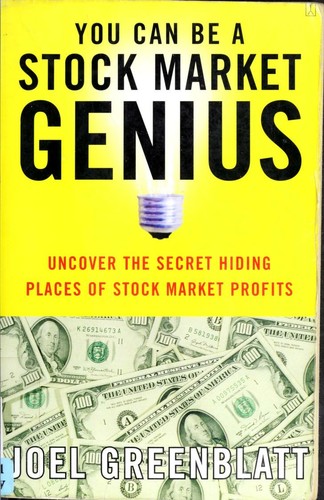
You Can Be a Stock Market Genius is Joel Greenblatt's guide to finding market-beating opportunities in corporate special situations: spinoffs, rights offerings, restructurings, mergers, and bankruptcies.
Joel Greenblatt · 1997 · 4h 15m
Full summary and key takeaways →The 12 questions
- 1.
Greenblatt argues individual investors have a structural edge over institutions in small special situations. Do you believe that edge still exists, given the growth of small hedge funds and dedicated event-driven strategies since 1997?
- 2.
The book requires reading SEC filings — Form 10s, proxy statements, S-1s. Have you ever read a full SEC filing? What stopped you?
- 3.
Greenblatt's approach requires doing work most investors won't do. Is that a sustainable competitive advantage, or does it erode as the approach becomes known?
- 4.
Spinoffs perform well partly because of forced institutional selling. Can you think of other situations where institutional constraints create systematic mispricings?
- 5.
How do you evaluate the claim that insider incentives in a spinoff — heavy management ownership — are a reliable signal of value? What could make that signal misleading?
- 6.
The case studies in the book are from the 1990s. How much of the logic transfers to current market conditions, and what has changed?
- 7.
Greenblatt focuses on situations where the mispricing has an identifiable catalyst for resolution. How important is the catalyst versus simply identifying something cheap?
- 8.
How much time per week would you need to dedicate to a special-situations approach to make it worthwhile, and is that realistic given your other commitments?
- 9.
The book covers distressed debt as well as equities. What additional skills or information would a retail investor need to evaluate distressed debt situations?
- 10.
Greenblatt's returns at Gotham Capital were extraordinary. How much of that performance came from the strategies in this book versus other factors — leverage, timing, access — that retail investors cannot replicate?
- 11.
What is the downside of the special-situations approach? What types of situations does Greenblatt avoid, and why?
- 12.
If you were to try one category of special situation from this book, which would it be and what would your first step be?
How to run the discussion
- Pick six to eight, not all of them. An hour of real discussion covers fewer questions than anyone expects, and racing the list is what makes a book club feel like homework.
- Open with what people noticed, not what they concluded. Asking for a verdict first hardens opinions before anyone has heard each other.
- Let the disagreement run. The questions below that split a room are the ones worth the time; the ones everyone answers the same way can be skipped.
- Ask the quiet person a specific question. A direct, narrow question is far easier to answer than an open invitation to contribute.
Themes worth steering toward
If the conversation stalls, these are the threads that usually restart it.
Common questions
What are good book club questions for You Can Be a Stock Market Genius?
Here are 12 book club questions for You Can Be a Stock Market Genius by Joel Greenblatt, ordered to open easily and end somewhere worth arguing about. The strongest openers ask what each reader noticed rather than what they concluded, and the discussion usually turns on special situations, value investing, spinoffs.
How long should a book club discussion of You Can Be a Stock Market Genius last?
Most groups run 60 to 90 minutes of actual discussion. That is roughly six to eight questions, not all of them, so pick the ones that suit your group rather than working down the list in order.
What are the main themes in You Can Be a Stock Market Genius?
Special situations, Value investing, Spinoffs, Mergers and acquisitions, Event-driven investing. Those are the threads most likely to divide a room, which makes them the useful places to steer a discussion that has gone quiet.
Picking the next one? See books like You Can Be a Stock Market Genius or questions for other book club picks.
