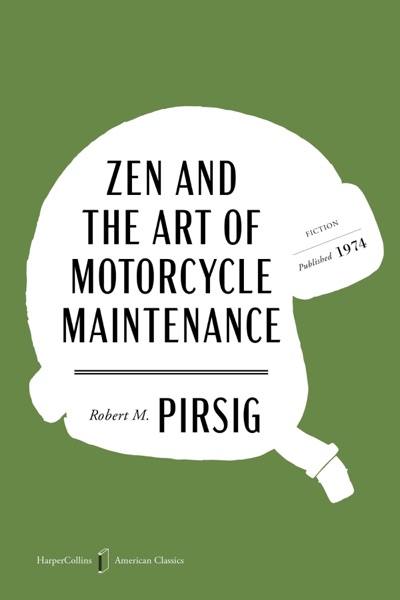
Talk to Zen and the Art of Motorcycle Maintenance like its author wrote you back.
Get the ideas that fit your life — not generic summaries.
- Chat with the book
- Audiobook-style main ideas
- Adapts to your life and goals
- Helps you take action
Zen and the Art of Motorcycle Maintenance, in detail
Robert Pirsig's 1974 book is structured as a cross-country motorcycle journey from Minnesota to California, narrated by a father traveling with his young son Chris. The surface story is a road trip. The deeper one is a philosophical inquiry into what Pirsig calls "Quality" — a concept he spent years trying to define and that eventually led to a mental breakdown, hospitalization, and electroconvulsive therapy. The narrator who begins the journey is not, he tells us, quite the same person as the man called Phaedrus who pursued that inquiry before.
Pirsig divides the world into two orientations: the "romantic" and the "classical." The romantic person sees a motorcycle as a whole — beautiful, unreliable, a mood. The classical person sees its parts, its systems, its maintenance logic. Pirsig argues that modern culture has split these two ways of knowing apart and placed them in opposition. His central argument is that Quality — real quality, not just good workmanship or taste — is the underlying reality that makes this split possible to heal. Quality isn't a property of things; it's the event of direct experience before the subject-object distinction kicks in.
The book's philosophical sections, called Chautauquas, alternate with the narrative. They trace the history of ideas from the pre-Socratics through Kant, examining how Western thought painted itself into a rationalist corner and produced a culture that relates to technology with anxiety or disdain. Pirsig's argument is not anti-technology. It's that the motorcycle mechanic who cares about the work — who brings genuine attention to each task — has more in common with the Zen monk than either would admit.
What readers carry away depends on where they meet the book. It works as a memoir of mental illness and a father-son story that turns genuinely dark by the end. It works as a critique of the fact-value split in modern philosophy. It also works as a meditation on why work done with care feels fundamentally different from work done without it. The book was rejected by 121 publishers before William Morrow accepted it, and it has sold over five million copies since.
The big ideas
- 1.
Quality is not a property of objects or a preference of subjects. Pirsig argues it is the event of experience itself — the pre-intellectual reality that both objective facts and subjective feelings are carved from.
- 2.
The romantic-classical split describes two ways of relating to the world: whole-pattern intuition versus analytical breakdown. Both are needed; the culture that severs them produces people who are estranged from their own tools and work.
- 3.
Care is the foundational virtue. If you bring genuine attention to a task — motorcycle maintenance, code, cooking — the quality of the output follows. Work done without care degrades regardless of skill.
