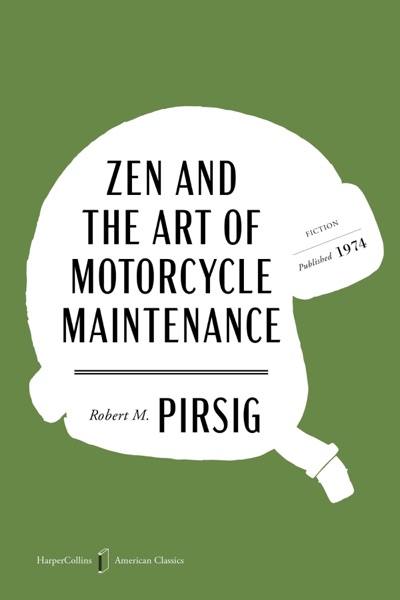
Zen and the Art of Motorcycle Maintenance by Robert Pirsig is a 1974 philosophy book about quality, rationalism and romanticism, self-discovery. Quality is not a property of objects or a preference of subjects. Pirsig argues it is the event of experience itself — the pre-intellectual reality that both objective facts and subjective feelings are carved from.
Summary
Robert Pirsig's 1974 book is structured as a cross-country motorcycle journey from Minnesota to California, narrated by a father traveling with his young son Chris. The surface story is a road trip. The deeper one is a philosophical inquiry into what Pirsig calls "Quality" — a concept he spent years trying to define and that eventually led to a mental breakdown, hospitalization, and electroconvulsive therapy. The narrator who begins the journey is not, he tells us, quite the same person as the man called Phaedrus who pursued that inquiry before.
Pirsig divides the world into two orientations: the "romantic" and the "classical." The romantic person sees a motorcycle as a whole — beautiful, unreliable, a mood. The classical person sees its parts, its systems, its maintenance logic. Pirsig argues that modern culture has split these two ways of knowing apart and placed them in opposition. His central argument is that Quality — real quality, not just good workmanship or taste — is the underlying reality that makes this split possible to heal. Quality isn't a property of things; it's the event of direct experience before the subject-object distinction kicks in.
The book's philosophical sections, called Chautauquas, alternate with the narrative. They trace the history of ideas from the pre-Socratics through Kant, examining how Western thought painted itself into a rationalist corner and produced a culture that relates to technology with anxiety or disdain. Pirsig's argument is not anti-technology. It's that the motorcycle mechanic who cares about the work — who brings genuine attention to each task — has more in common with the Zen monk than either would admit.
What readers carry away depends on where they meet the book. It works as a memoir of mental illness and a father-son story that turns genuinely dark by the end. It works as a critique of the fact-value split in modern philosophy. It also works as a meditation on why work done with care feels fundamentally different from work done without it. The book was rejected by 121 publishers before William Morrow accepted it, and it has sold over five million copies since.
Talk to Zen and the Art of Motorcycle Maintenance like its author wrote you back.
Get the ideas that fit your life — not generic summaries.
- Chat with the book
- Audiobook-style main ideas
- Adapts to your life and goals
- Helps you take action
Key takeaways
- 1.
Quality is not a property of objects or a preference of subjects. Pirsig argues it is the event of experience itself — the pre-intellectual reality that both objective facts and subjective feelings are carved from.
- 2.
The romantic-classical split describes two ways of relating to the world: whole-pattern intuition versus analytical breakdown. Both are needed; the culture that severs them produces people who are estranged from their own tools and work.
- 3.
Care is the foundational virtue. If you bring genuine attention to a task — motorcycle maintenance, code, cooking — the quality of the output follows. Work done without care degrades regardless of skill.
- 4.
The ghost of rationality haunts Western philosophy. Pirsig traces how the primacy of logos over arête in ancient Greece embedded a problematic hierarchy that still shapes how science and the humanities relate to each other.
- 5.
Mental illness is present in the book not as a backstory but as a structural fact. Phaedrus pursued the concept of Quality to its logical extreme and lost the self that was doing the pursuing.
- 6.
Gumption — Pirsig's term for the psychic energy required to engage difficult work — can be drained by anxiety, impatience, and ego. Recognizing gumption traps is a practical skill.
- 7.
The father-son journey is not resolved cleanly. Chris's suffering throughout the trip has causes the narrator is too caught in his own inquiry to fully see until near the end.
- 8.
Technology is not the problem. The problem is the relationship to technology — whether it's experienced as alien machinery or as an extension of human purpose and attention.
Discussion questions
Use these on your own, with a book club, or as chat starters in Superbook. Book club version, ready to copy or print →
- 1.
Pirsig separates romantic and classical orientations. Which one describes you more naturally, and where has that orientation served you badly?
- 2.
The book argues that care — genuine attention to the work — is more fundamental than skill or intelligence. Can you think of work you've done where care made a visible difference in quality?
- 3.
Pirsig's Phaedrus is destroyed by his own philosophical pursuit. What does it mean to follow an idea too far? Have you ever been inside a thought that felt genuinely dangerous?
- 4.
The motorcycle maintenance sections are oddly calming. What is Pirsig suggesting about the relationship between careful attention to physical problems and peace of mind?
- 5.
Pirsig argues Quality is pre-intellectual — experienced before the mind divides it into subject and object. Does that claim seem plausible to you, or does it feel like mystification?
- 6.
The narrator and Phaedrus are the same person, but the narrator treats Phaedrus almost as an enemy. What does that suggest about the relationship between who we are now and who we were at our most intense?
- 7.
How does Pirsig's critique of rationalism apply to institutions you've worked in? Do those institutions reward classical or romantic thinking, and what gets lost?
- 8.
Gumption traps are the internal or external conditions that drain the energy required to engage hard work. What are your main gumption traps, and what restores your gumption?
- 9.
The book was written about a specific historical moment — post-1960s disillusionment with both technocracy and counterculture. Does its diagnosis of cultural split feel more or less relevant now?
- 10.
Chris is largely silent throughout the trip and clearly struggling. How does the narrator's philosophical obsession function as a form of absence from his son?
- 11.
Pirsig suggests that the Zen monk and the excellent mechanic share something the intellectual often lacks. What is that thing, and do you see it in anyone you know?
- 12.
The book ends on an optimistic but fragile note. Given what you know about Pirsig's life after publication — Chris died young, Pirsig himself remained troubled — does the ending read differently?
Themes
Frequently asked questions
-
Is Zen and the Art of Motorcycle Maintenance actually about Zen?
Not really. Pirsig uses Zen as a reference point for the quality of direct, undivided attention, but he does not teach Zen Buddhism. The title is deliberately provocative — the book is more about Western philosophy, the nature of quality, and the cultural split between analytical and intuitive ways of knowing.
-
Is Zen and the Art of Motorcycle Maintenance worth reading?
Yes, but with patience. The philosophical sections can feel dense and the narrative pacing is unusual. Readers who stay with it generally find the central argument about Quality and care genuinely illuminating, and the emotional arc of the father-son story becomes more powerful in retrospect.
-
How difficult is Zen and the Art of Motorcycle Maintenance to read?
Moderately difficult. The motorcycle maintenance passages are accessible; the Chautauqua sections move through Plato, Kant, and empiricism at speed. Philosophy readers will find it easier than general readers, but the book was written for a general audience and explains its technical concepts as it goes.
-
What is Pirsig's main philosophical claim?
That Quality — direct, pre-intellectual experience of excellence — is ontologically prior to both subjects and objects. This is his solution to the Cartesian mind-body split and to what he sees as a culture that has severed analytical thinking from felt meaning.
-
Who should read this book?
People who feel alienated from technology, people interested in where Western philosophy went wrong, and people who have noticed that work done with genuine care feels qualitatively different from work done without it. Not ideal for readers wanting a tight argument — Pirsig sprawls.