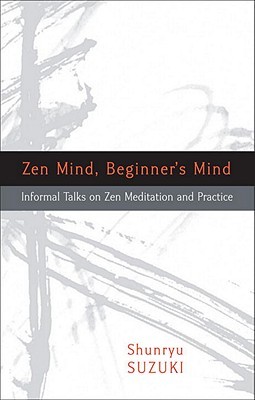
Talk to Zen Mind, Beginner's Mind like its author wrote you back.
Get the ideas that fit your life — not generic summaries.
- Chat with the book
- Audiobook-style main ideas
- Adapts to your life and goals
- Helps you take action
What it argues
Zen Mind, Beginner's Mind is a collection of informal talks given by Shunryu Suzuki to his students at the San Francisco Zen Center in the late 1960s, edited and compiled by Trudy Dixon and published in 1970. It has become the most widely read Zen text in the English-speaking world — a status it has held for over fifty years without ever trying to be definitive or systematic. Its authority comes entirely from the quality of attention behind the words.
The book's organizing principle is the concept of beginner's mind — shoshin in Japanese. In the beginner's mind there are many possibilities; in the expert's mind there are few. This is not false modesty but a precise observation: expertise can foreclose perception, filling the space where direct experience should be with concepts, comparisons, and conclusions. Practice in Suzuki's teaching means maintaining the open, questioning quality of someone encountering something for the first time, even when doing something familiar for the ten-thousandth time.
What it gets right
- 1.
In the beginner's mind there are many possibilities; in the expert's mind there are few. Keeping beginner's mind — open, questioning, free of fixed ideas — is the whole of Zen practice.
- 2.
Proper posture in zazen is not a means to enlightenment but an expression of it: sitting fully, without expectation or agenda, is itself the practice.
- 3.
Right effort is not too tight and not too loose — the middle way between forcing and abandoning, applied moment to moment in practice and daily life.
What it covers
Who wrote it
Shunryu Suzuki (1904–1971) was a Japanese Soto Zen monk and teacher who came to San Francisco in 1959 to serve the Japanese-American community and found himself drawn to teaching Westerners who wanted to practice zazen. He founded the San Francisco Zen Center in 1962 and Tassajara Zen Mountain Center in 1967 — the first Zen training monastery outside Asia. He is credited with introducing Soto Zen practice to the English-speaking world. Zen Mind, Beginner's Mind was compiled from his talks and published the year of his death from cancer in 1971.
