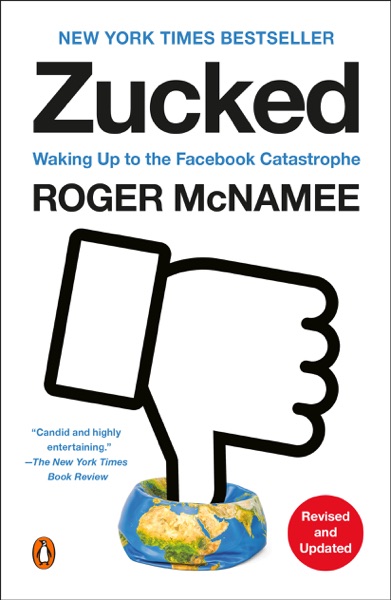
Talk to Zucked: Waking Up to the Facebook Catastrophe like its author wrote you back.
Get the ideas that fit your life — not generic summaries.
- Chat with the book
- Audiobook-style main ideas
- Adapts to your life and goals
- Helps you take action
Zucked: Waking Up to the Facebook Catastrophe, in detail
Zucked is Roger McNamee's account of his transformation from Facebook champion to critic. McNamee was an early investor and informal mentor to Mark Zuckerberg in the mid-2000s, when he introduced Zuckerberg to Sheryl Sandberg and helped shape the company's early strategic direction. He became one of the company's loudest external critics starting in 2016, when he noticed unusual behavioral patterns in Facebook's user activity that he connected to the Brexit campaign and, later, to the 2016 US presidential election. The book is both a personal reckoning and a policy argument.
McNamee's central claim is that Facebook's business model — optimizing for engagement above all else — is structurally incompatible with a healthy democracy and a functioning society. Engagement optimization, he argues, does not produce the best content or the most accurate information. It produces the most emotionally activating content: outrage, fear, tribalism, and conspiracy. The algorithm is not malicious; it is indifferent. But indifference to truth, at Facebook's scale, produces outcomes that McNamee considers catastrophic.
The book traces the rise of the platform, the development of its advertising model, the role of Cambridge Analytica in harvesting user data for political manipulation, and the company's response to criticism, which McNamee characterizes as a combination of denial, deflection, and minimal concession. He argues that Zuckerberg and Sandberg are not uniquely villainous but that they have built an institution whose financial incentives make it resistant to the self-correction that would be required to reduce the harms.
McNamee's prescriptions center on regulatory intervention: treating Facebook as a public utility, enforcing antitrust law, requiring algorithmic transparency, and banning the microtargeted political advertising he believes is particularly corrosive. The policy section is less detailed than the diagnostic section, and some readers will find his faith in regulatory solutions optimistic given the pace of political institutions relative to technology. But the diagnosis — that a platform optimizing for engagement at the expense of accuracy and social trust is a public health problem — is argued with unusual insider authority.
The big ideas
- 1.
Facebook's engagement-optimization model rewards emotionally activating content regardless of accuracy, because outrage and fear drive longer sessions and more sharing than truth.
- 2.
The platform's scale — billions of daily users — means that even small algorithmic biases toward engagement over accuracy produce large aggregate effects on political discourse and social trust.
- 3.
Cambridge Analytica's data harvesting was possible not because Facebook was hacked but because the platform's architecture was designed to share user data broadly with third-party developers.
