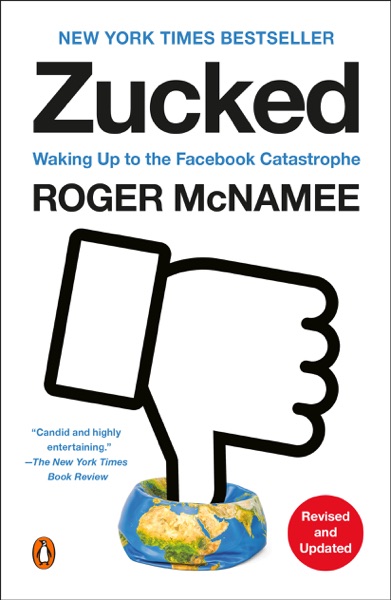
Zucked: Waking Up to the Facebook Catastrophe by Roger McNamee is a 2019 business book about technology, social media, democracy. Facebook's engagement-optimization model rewards emotionally activating content regardless of accuracy, because outrage and fear drive longer sessions and more sharing than truth.
Summary
Zucked is Roger McNamee's account of his transformation from Facebook champion to critic. McNamee was an early investor and informal mentor to Mark Zuckerberg in the mid-2000s, when he introduced Zuckerberg to Sheryl Sandberg and helped shape the company's early strategic direction. He became one of the company's loudest external critics starting in 2016, when he noticed unusual behavioral patterns in Facebook's user activity that he connected to the Brexit campaign and, later, to the 2016 US presidential election. The book is both a personal reckoning and a policy argument.
McNamee's central claim is that Facebook's business model — optimizing for engagement above all else — is structurally incompatible with a healthy democracy and a functioning society. Engagement optimization, he argues, does not produce the best content or the most accurate information. It produces the most emotionally activating content: outrage, fear, tribalism, and conspiracy. The algorithm is not malicious; it is indifferent. But indifference to truth, at Facebook's scale, produces outcomes that McNamee considers catastrophic.
The book traces the rise of the platform, the development of its advertising model, the role of Cambridge Analytica in harvesting user data for political manipulation, and the company's response to criticism, which McNamee characterizes as a combination of denial, deflection, and minimal concession. He argues that Zuckerberg and Sandberg are not uniquely villainous but that they have built an institution whose financial incentives make it resistant to the self-correction that would be required to reduce the harms.
McNamee's prescriptions center on regulatory intervention: treating Facebook as a public utility, enforcing antitrust law, requiring algorithmic transparency, and banning the microtargeted political advertising he believes is particularly corrosive. The policy section is less detailed than the diagnostic section, and some readers will find his faith in regulatory solutions optimistic given the pace of political institutions relative to technology. But the diagnosis — that a platform optimizing for engagement at the expense of accuracy and social trust is a public health problem — is argued with unusual insider authority.
Talk to Zucked: Waking Up to the Facebook Catastrophe like its author wrote you back.
Get the ideas that fit your life — not generic summaries.
- Chat with the book
- Audiobook-style main ideas
- Adapts to your life and goals
- Helps you take action
Key takeaways
- 1.
Facebook's engagement-optimization model rewards emotionally activating content regardless of accuracy, because outrage and fear drive longer sessions and more sharing than truth.
- 2.
The platform's scale — billions of daily users — means that even small algorithmic biases toward engagement over accuracy produce large aggregate effects on political discourse and social trust.
- 3.
Cambridge Analytica's data harvesting was possible not because Facebook was hacked but because the platform's architecture was designed to share user data broadly with third-party developers.
- 4.
McNamee argues that Zuckerberg and Sandberg are not primarily dishonest but that their financial incentives and worldview make it difficult for them to accurately assess the harms their platform produces.
- 5.
Regulatory approaches rather than voluntary corporate reform are McNamee's prescription, because the business model that produces the harm is also the business model that makes the company valuable.
- 6.
Microtargeted political advertising is particularly corrosive because it allows campaigns to send different and contradictory messages to different audiences without accountability.
- 7.
The company's crisis management pattern — acknowledge a specific harm, make a minimal change, declare the problem solved — has been repeated enough times to be recognizable as a strategy rather than a response.
- 8.
Monopoly power in social media reduces competitive pressure to reform: users who want to leave Facebook face a social network penalty because their connections are there.
Discussion questions
Use these on your own, with a book club, or as chat starters in Superbook. Book club version, ready to copy or print →
- 1.
McNamee moved from insider advocate to public critic. What do you think he saw in 2016 that his earlier self would have dismissed?
- 2.
He argues the engagement model is structurally incompatible with accurate information at scale. Is that a solvable engineering problem, or does it require a different business model entirely?
- 3.
Cambridge Analytica was not a hack — it used the platform as designed. Does that change how you think about the concept of 'data breach'?
- 4.
McNamee argues Facebook's executives are not primarily dishonest but are limited by their own worldview and incentives. How do you evaluate a leader's culpability when they may genuinely not see the harm they're causing?
- 5.
His policy prescriptions rely heavily on regulatory intervention. Are those prescriptions realistic given the speed of technology change relative to legislative processes?
- 6.
Zucked was published in 2019. Which of McNamee's concerns have become more pressing since then, and which have been addressed — at least partially?
- 7.
He draws parallels between Facebook's algorithm and tobacco companies' denial of health harms. How apt is that analogy? Where does it hold and where does it fail?
- 8.
McNamee is himself a wealthy technology investor who benefited from the same venture capital ecosystem that produced Facebook. How does that position affect the credibility of his critique?
- 9.
He argues that microtargeted political advertising should be banned. What would be the collateral effects of such a ban on legitimate political speech?
- 10.
The book focuses almost entirely on Facebook. Is the problem specific to Facebook's culture and decisions, or is it structural to all large social media platforms?
- 11.
How much of your own news consumption and social interaction goes through Facebook or Instagram? Has reading this book changed how you think about that?
- 12.
McNamee says Facebook has become too powerful to self-regulate. Is there a historical precedent for an institution of that power reforming itself without external compulsion?
Themes
Frequently asked questions
-
Is Zucked worth reading in 2026?
Yes, particularly for the diagnostic section on how engagement optimization works and why it is structurally disposed to amplify harmful content. The policy prescriptions feel somewhat dated given subsequent regulatory developments, but the core argument about Facebook's business model and its social effects remains relevant.
-
Is McNamee's critique fair to Zuckerberg and Sandberg?
He is notably more measured than many critics, crediting both with genuine belief in their own narrative rather than deliberate malice. Whether that is fair depends on how you weigh intent against outcome. He is less interested in assigning personal blame than in describing the institutional dynamics that make reform difficult.
-
Does McNamee have an axe to grind?
He was an early advocate and informal advisor who became a public critic. His credibility comes from his insider access; his potential bias comes from the same source. He acknowledges that his criticism cost him relationships in the technology industry.
-
How long does it take to read Zucked?
About five hours for the 300-page book. The narrative chapters on McNamee's relationship with Facebook and the 2016 election observations read quickly; the policy chapters are denser.
-
Who should read Zucked?
Anyone who uses Facebook, Instagram, or WhatsApp and wants to understand the incentive structure behind the platforms, and anyone interested in the intersection of technology, democracy, and platform regulation. It is most useful for readers who have some background in technology but are not immersed in the academic literature on social media harms.
Similar books
The Age of Surveillance Capitalism: The Fight for a Human Future at the New Frontier of Power
Shoshana Zuboff
No Filter: The Inside Story of Instagram
Sarah Frier
Super Pumped: The Battle for Uber
Mike Isaac
Bad Blood: Secrets and Lies in a Silicon Valley Startup
John Carreyrou
