History · Book club
1776 book club questions
Here are 12 book club questions for 1776 by David McCullough, ordered to open easily and end somewhere worth arguing about. Copy them, print them, or bring them up one at a time.
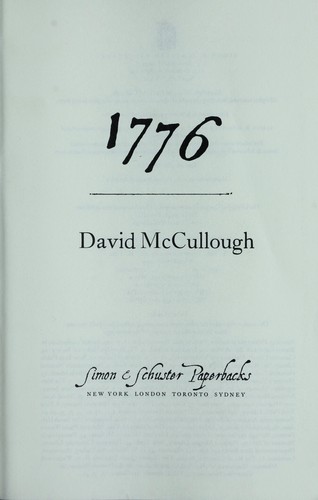
David McCullough's 1776, published in 2005, covers a single year of the American Revolution — from the winter siege of Boston through Washington's crossing of the Delaware and the surprise victory at Trenton.
David McCullough · 2005 · 8h 0m
Full summary and key takeaways →The 12 questions
- 1.
McCullough focuses on a single year rather than the full Revolution. What does that narrow focus reveal that a broader account would miss?
- 2.
Washington made serious errors in New York. How do you evaluate a leader whose success comes less from tactical brilliance than from the ability to recover from mistakes?
- 3.
Howe had multiple opportunities to end the war and didn't take them. What does McCullough suggest about his reasons, and does that explanation satisfy you?
- 4.
The Continental Army was constantly on the edge of dissolution. What kept it together when material conditions and military results were so discouraging?
- 5.
McCullough gives significant attention to ordinary soldiers through their letters and journals. What do those accounts reveal that the strategic narrative alone cannot?
- 6.
The crossing of the Delaware is one of the most famous moments in American history. Does reading the actual account in detail change how you understand it?
- 7.
The book suggests that much of the surrounding population was indifferent or Loyalist. How does that complicate the popular narrative of a united patriot cause?
- 8.
British officers wrote letters and journals that McCullough quotes extensively. What does their perspective add to the account?
- 9.
1776 is a much shorter book than McCullough's John Adams or Truman. Does the compression serve the subject, or do you feel something important is missing?
- 10.
The survival of the Continental Army through 1776 required luck as well as perseverance. How do you weigh contingency and character in explaining the Revolution's eventual success?
- 11.
What does this account of the Revolution's military reality suggest about how we commemorate it today?
- 12.
If the crossing of the Delaware had failed or the attack at Trenton had been repulsed, how close was the war to ending in British victory?
How to run the discussion
- Pick six to eight, not all of them. An hour of real discussion covers fewer questions than anyone expects, and racing the list is what makes a book club feel like homework.
- Open with what people noticed, not what they concluded. Asking for a verdict first hardens opinions before anyone has heard each other.
- Let the disagreement run. The questions below that split a room are the ones worth the time; the ones everyone answers the same way can be skipped.
- Ask the quiet person a specific question. A direct, narrow question is far easier to answer than an open invitation to contribute.
Themes worth steering toward
If the conversation stalls, these are the threads that usually restart it.
Common questions
What are good book club questions for 1776?
Here are 12 book club questions for 1776 by David McCullough, ordered to open easily and end somewhere worth arguing about. The strongest openers ask what each reader noticed rather than what they concluded, and the discussion usually turns on american revolution, military leadership, perseverance.
How long should a book club discussion of 1776 last?
Most groups run 60 to 90 minutes of actual discussion. That is roughly six to eight questions, not all of them, so pick the ones that suit your group rather than working down the list in order.
What are the main themes in 1776?
American Revolution, Military leadership, Perseverance, National founding. Those are the threads most likely to divide a room, which makes them the useful places to steer a discussion that has gone quiet.
Picking the next one? See books like 1776 or questions for other book club picks.
