Philosophy · Book club
1984 book club questions
Here are 12 book club questions for 1984 by George Orwell, ordered to open easily and end somewhere worth arguing about. Copy them, print them, or bring them up one at a time.
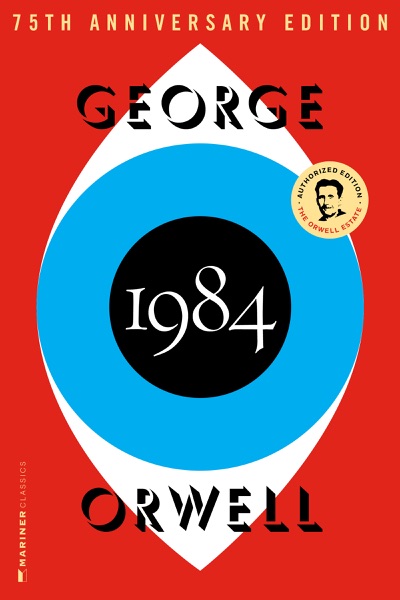
Nineteen Eighty-Four is George Orwell's 1949 novel about a future England called Airstrip One, governed by the totalitarian Party under the figurehead Big Brother.
George Orwell · 1949 · 6h 0m
Full summary and key takeaways →The 12 questions
- 1.
Orwell wrote the novel as a warning about existing tendencies rather than a prediction. Which elements of the world he describes feel most recognizable in current institutions or media environments?
- 2.
Winston's rebellion begins as thought — a private diary he knows will get him killed. What does Orwell think about the relationship between private thought and political action?
- 3.
Julia represents a different form of resistance than Winston's: apolitical, embodied, private. Who does Orwell seem to think is more realistic, and is he right?
- 4.
Doublethink is presented as a conscious technique, not a confusion. Can you think of examples of doublethink in contemporary public discourse, where contradictions are held deliberately rather than from ignorance?
- 5.
The proles are left alone because they have no political consciousness. Is Orwell pessimistic about ordinary people, or is he making a specific point about how political consciousness is suppressed?
- 6.
O'Brien's explanation of the Party's motives — power for its own sake, not for any goal — is chilling. Does it feel psychologically plausible, or is it too pure a form of evil to be realistic?
- 7.
The appendix is written in the past tense, suggesting the Party eventually failed. How does that choice change your reading of the novel? Is it consoling or does it make the story darker?
- 8.
Newspeak's project of eliminating vocabulary for dissent maps onto real debates about political language. Which contemporary language debates remind you most of Orwell's concerns?
- 9.
Winston's love for Julia and his love for O'Brien are both used against him. What does Orwell think relationships are in an authoritarian state — an asset or a vulnerability?
- 10.
The torture in the Ministry of Love is aimed at genuine transformation, not confession or compliance. Does that make it more or less imaginable than more conventional brutality?
- 11.
Orwell said he wrote 1984 partly to expose Stalinist tendencies on the left as well as fascist tendencies on the right. Does reading it that way change anything in how you read the novel?
- 12.
What does the novel say about hope? Is there a version of the story that Orwell thinks could end differently, or is the outcome determined from the beginning?
How to run the discussion
- Pick six to eight, not all of them. An hour of real discussion covers fewer questions than anyone expects, and racing the list is what makes a book club feel like homework.
- Open with what people noticed, not what they concluded. Asking for a verdict first hardens opinions before anyone has heard each other.
- Let the disagreement run. The questions below that split a room are the ones worth the time; the ones everyone answers the same way can be skipped.
- Ask the quiet person a specific question. A direct, narrow question is far easier to answer than an open invitation to contribute.
Themes worth steering toward
If the conversation stalls, these are the threads that usually restart it.
Common questions
What are good book club questions for 1984?
Here are 12 book club questions for 1984 by George Orwell, ordered to open easily and end somewhere worth arguing about. The strongest openers ask what each reader noticed rather than what they concluded, and the discussion usually turns on totalitarianism, surveillance, language and power.
How long should a book club discussion of 1984 last?
Most groups run 60 to 90 minutes of actual discussion. That is roughly six to eight questions, not all of them, so pick the ones that suit your group rather than working down the list in order.
What are the main themes in 1984?
Totalitarianism, Surveillance, Language and power, Resistance, Truth. Those are the threads most likely to divide a room, which makes them the useful places to steer a discussion that has gone quiet.
Picking the next one? See books like 1984 or questions for other book club picks.
