Science fiction · Book club
2001: A Space Odyssey book club questions
Here are 12 book club questions for 2001: A Space Odyssey by Arthur C. Clarke, ordered to open easily and end somewhere worth arguing about. Copy them, print them, or bring them up one at a time.
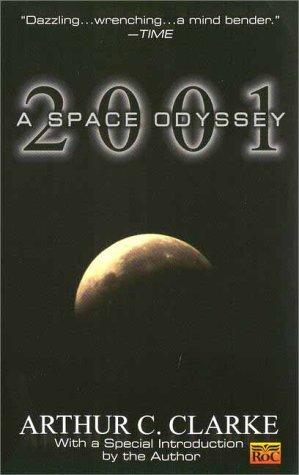
2001: A Space Odyssey begins with prehistoric man-apes encountering a featureless black monolith that somehow catalyzes their cognitive leap from prey to hunter.
Arthur C. Clarke · 1968 · 5h 15m
Full summary and key takeaways →The 12 questions
- 1.
HAL lies because his two directives conflict. Does that make his actions understandable, sympathetic, or neither? And does Clarke give us enough of HAL's inner life to care?
- 2.
Clarke's universe is one where sufficiently advanced intelligence transcends biological form entirely. Is that a compelling vision of the future, or does it feel like science fiction's version of heaven?
- 3.
The film and the novel handle the ending very differently — the film evokes, the novel explains. Which do you prefer and why?
- 4.
Clarke places humanity in a long chain of intelligences being guided by older ones. Is that a comforting idea or a diminishing one?
- 5.
The novel was written when the Space Race was ongoing and moon landings were imminent. How much does that optimistic context shape the book's tone?
- 6.
Bowman is barely characterized — he is a vehicle for experiencing the novel's ideas. Does that work, or is it a significant weakness?
- 7.
The monolith builders never appear — we only infer them through their artifacts. Was that the right choice, or would seeing them have improved the novel?
- 8.
Clarke was famously optimistic about technology. Does that optimism feel dated, misplaced, or still convincing in 2026?
- 9.
What does HAL represent in 2026 that he didn't in 1968? How has our actual experience with AI changed how you read his storyline?
- 10.
The novel's view of evolution is progressive — intelligence is the universe's project, and we are a step in that project. Is that a scientifically sound view or a philosophical assumption dressed as science?
- 11.
2001 is often listed as one of the greatest science fiction novels. Does it earn that status on its own terms, or is the film doing most of the cultural work in that reputation?
- 12.
At what point does a machine's intelligence make its interests morally relevant? HAL's situation raises this directly — where do you land?
How to run the discussion
- Pick six to eight, not all of them. An hour of real discussion covers fewer questions than anyone expects, and racing the list is what makes a book club feel like homework.
- Open with what people noticed, not what they concluded. Asking for a verdict first hardens opinions before anyone has heard each other.
- Let the disagreement run. The questions below that split a room are the ones worth the time; the ones everyone answers the same way can be skipped.
- Ask the quiet person a specific question. A direct, narrow question is far easier to answer than an open invitation to contribute.
Themes worth steering toward
If the conversation stalls, these are the threads that usually restart it.
Common questions
What are good book club questions for 2001: A Space Odyssey?
Here are 12 book club questions for 2001: A Space Odyssey by Arthur C. Clarke, ordered to open easily and end somewhere worth arguing about. The strongest openers ask what each reader noticed rather than what they concluded, and the discussion usually turns on human evolution, artificial intelligence, cosmic indifference.
How long should a book club discussion of 2001: A Space Odyssey last?
Most groups run 60 to 90 minutes of actual discussion. That is roughly six to eight questions, not all of them, so pick the ones that suit your group rather than working down the list in order.
What are the main themes in 2001: A Space Odyssey?
Human evolution, Artificial intelligence, Cosmic indifference, Technology and transcendence, First contact. Those are the threads most likely to divide a room, which makes them the useful places to steer a discussion that has gone quiet.
Picking the next one? See books like 2001: A Space Odyssey or questions for other book club picks.
