Philosophy · Book club
21 Lessons for the 21st Century book club questions
Here are 12 book club questions for 21 Lessons for the 21st Century by Yuval Noah Harari, ordered to open easily and end somewhere worth arguing about. Copy them, print them, or bring them up one at a time.
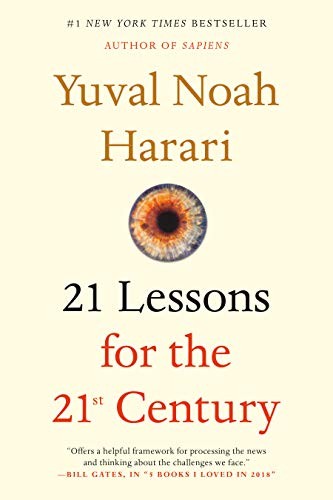
Where Sapiens traced humanity's past and Homo Deus speculated about its future, 21 Lessons for the 21st Century plants itself in the present.
Yuval Noah Harari · 2018 · 6h 45m
Full summary and key takeaways →The 12 questions
- 1.
Harari argues that automation will displace cognitive as well as manual workers. Which professions in your field feel most and least at risk, and why?
- 2.
The book claims liberal democracy's legitimacy depends on a particular story about human agency. How does that story hold up against what you know about how people actually make decisions?
- 3.
Harari is skeptical that individuals can meaningfully consent to how their data is used. Do you find that argument convincing, or is it too defeatist?
- 4.
Which of the twenty-one lessons felt most urgent to you personally, and which felt most overstated?
- 5.
The nationalism chapter argues that national identity offers comfort but not solutions to global problems. Is there a version of nationalism that Harari is too quick to dismiss?
- 6.
Harari says humans are better at identifying external threats than internal ones — including the biases of our own minds. Where in your own thinking do you notice that pattern?
- 7.
The section on religion treats faith traditions primarily as meaning-making narratives. How fair do you think that framing is to people who hold sincere religious beliefs?
- 8.
Harari's chapter on meditation is explicitly personal. Does a public intellectual's private practice belong in a book like this, or is it a distraction from the political argument?
- 9.
The book argues that resilience and adaptability matter more than specific skills. What would it actually look like to optimize for those things in your own life or career?
- 10.
Harari suggests that most people will need to reinvent themselves professionally multiple times in the coming decades. What would make that easier or harder for the people you know?
- 11.
The chapter on truth argues we are not well-equipped to separate reliable information from plausible fiction. How do you personally try to manage that problem, and how well does it work?
- 12.
Where do you think Harari's argument is weakest? Which of his twenty-one lessons feels most like a placeholder for a question he couldn't fully answer?
How to run the discussion
- Pick six to eight, not all of them. An hour of real discussion covers fewer questions than anyone expects, and racing the list is what makes a book club feel like homework.
- Open with what people noticed, not what they concluded. Asking for a verdict first hardens opinions before anyone has heard each other.
- Let the disagreement run. The questions below that split a room are the ones worth the time; the ones everyone answers the same way can be skipped.
- Ask the quiet person a specific question. A direct, narrow question is far easier to answer than an open invitation to contribute.
Themes worth steering toward
If the conversation stalls, these are the threads that usually restart it.
Common questions
What are good book club questions for 21 Lessons for the 21st Century?
Here are 12 book club questions for 21 Lessons for the 21st Century by Yuval Noah Harari, ordered to open easily and end somewhere worth arguing about. The strongest openers ask what each reader noticed rather than what they concluded, and the discussion usually turns on technology and society, political disillusionment, meaning.
How long should a book club discussion of 21 Lessons for the 21st Century last?
Most groups run 60 to 90 minutes of actual discussion. That is roughly six to eight questions, not all of them, so pick the ones that suit your group rather than working down the list in order.
What are the main themes in 21 Lessons for the 21st Century?
Technology and society, Political disillusionment, Meaning, Artificial intelligence, Nationalism, Truth and information. Those are the threads most likely to divide a room, which makes them the useful places to steer a discussion that has gone quiet.
Picking the next one? See books like 21 Lessons for the 21st Century or questions for other book club picks.
