Science fiction · Book club
A Fire Upon the Deep book club questions
Here are 12 book club questions for A Fire Upon the Deep by Vernor Vinge, ordered to open easily and end somewhere worth arguing about. Copy them, print them, or bring them up one at a time.
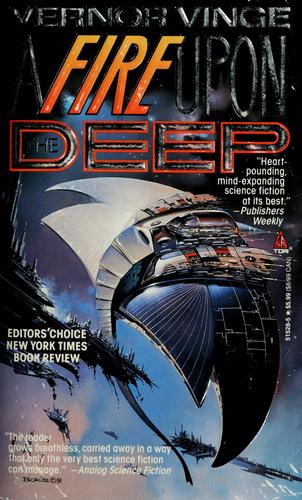
The galaxy in A Fire Upon the Deep is zoned by the speed of thought: near the galactic core, the Slowness, where intelligence itself is limited; farther out, the Unthinking Depths; and further still, the Transcend, where entities of incomprehensible intelligence emerge and occasionally intervene in the affairs of the merely civilized.
Vernor Vinge · 1992 · 12h 15m
Full summary and key takeaways →The 12 questions
- 1.
The Zone concept physically limits intelligence near the galactic core. Does Vinge seem to think this limitation is a loss, a fact, or something that should push beings toward the Transcend?
- 2.
The Tines are a pack species whose individuals are fragments of a collective mind. When a pack-member is killed, who is it that dies? Does the novel seem to have a settled view on this?
- 3.
Johanna and Jefri are separated early and have radically different experiences on Tines' World. By the novel's end, how differently have their experiences shaped them, and does the book treat that difference with judgment?
- 4.
The galactic Net is full of information about the Blight, much of it unreliable or deliberately misleading. What is Vinge doing with that internet-before-the-internet in a 1992 novel?
- 5.
The Blight is not motivated by hatred or conquest in any recognizable sense. What does Vinge gain, narratively, by making his antagonist cognitively alien rather than simply powerful and malevolent?
- 6.
The novel is very long and the opening sections are dense with world-building. At what point did it click into full gear for you, and what made the difference?
- 7.
Transcend entities occasionally intervene in the affairs of lesser civilizations. Does the novel seem to think this is benevolent, predatory, or simply incomprehensible from a human standpoint?
- 8.
Vinge imagines different species coexisting in the Beyond and communicating through a shared network. What assumptions does he make about translatability and shared interest that seem optimistic, and where does the novel complicate those assumptions?
- 9.
The weapon that might stop the Blight is the novel's MacGuffin. How much does Vinge succeed in making the stakes of the race to retrieve it feel genuinely personal rather than abstractly cosmic?
- 10.
A Fire Upon the Deep shares DNA with other big-canvas SF: Asimov's Foundation, Stapledon's Star Maker, Banks's Culture novels. Where does it sit in that tradition and what does it contribute that its predecessors didn't?
- 11.
The novel ends on a note that implies continuation — A Deepness in the Sky is a loosely linked prequel/companion. Does A Fire Upon the Deep feel complete as a standalone, or does the ending require sequel knowledge?
- 12.
The human characters are less vividly drawn than the Tines. Is that a problem with the novel or a reflection of its thematic priorities?
How to run the discussion
- Pick six to eight, not all of them. An hour of real discussion covers fewer questions than anyone expects, and racing the list is what makes a book club feel like homework.
- Open with what people noticed, not what they concluded. Asking for a verdict first hardens opinions before anyone has heard each other.
- Let the disagreement run. The questions below that split a room are the ones worth the time; the ones everyone answers the same way can be skipped.
- Ask the quiet person a specific question. A direct, narrow question is far easier to answer than an open invitation to contribute.
Themes worth steering toward
If the conversation stalls, these are the threads that usually restart it.
Common questions
What are good book club questions for A Fire Upon the Deep?
Here are 12 book club questions for A Fire Upon the Deep by Vernor Vinge, ordered to open easily and end somewhere worth arguing about. The strongest openers ask what each reader noticed rather than what they concluded, and the discussion usually turns on transcendence and intelligence, communication across difference, civilizational scale and the individual.
How long should a book club discussion of A Fire Upon the Deep last?
Most groups run 60 to 90 minutes of actual discussion. That is roughly six to eight questions, not all of them, so pick the ones that suit your group rather than working down the list in order.
What are the main themes in A Fire Upon the Deep?
Transcendence and intelligence, Communication across difference, Civilizational scale and the individual, Collective vs. individual identity, Technology and dependency. Those are the threads most likely to divide a room, which makes them the useful places to steer a discussion that has gone quiet.
Picking the next one? See books like A Fire Upon the Deep or questions for other book club picks.
