Psychology · Book club
A General Theory of Love book club questions
Here are 11 book club questions for A General Theory of Love by Thomas Lewis, Fari Amini, and Richard Lannon, ordered to open easily and end somewhere worth arguing about. Copy them, print them, or bring them up one at a time.
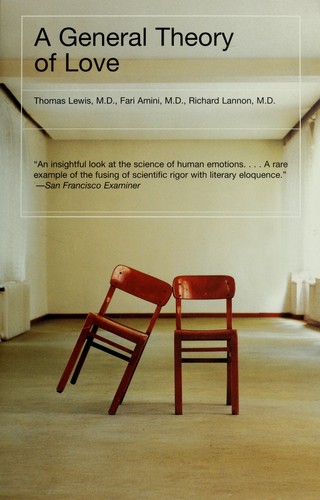
A General Theory of Love is a 2000 book by three psychiatrists at the University of California, San Francisco — Thomas Lewis, Fari Amini, and Richard Lannon — who set out to explain love scientifically without stripping it of its significance.
Thomas Lewis, Fari Amini, and Richard Lannon · 2000 · 5h 15m
Full summary and key takeaways →The 11 questions
- 1.
The book argues that attraction to familiar emotional patterns explains many puzzling relationship choices. Does this framework help you understand any recurring patterns in your own relationships?
- 2.
Lewis and his co-authors claim that limbic regulation — physical proximity and emotional attunement — is as necessary as food. How do the people in your life currently affect your nervous system, for better or worse?
- 3.
The authors distinguish between the limbic brain's emotional learning and the neocortex's rational understanding. Can you identify places in your life where you understand something fully but behave differently anyway?
- 4.
What does the book's skepticism about insight-based therapy suggest about how you seek change in yourself? What has actually shifted your emotional patterns versus what has just clarified your understanding of them?
- 5.
The claim that early caregiving creates lifelong templates is both explanatory and potentially fatalistic. How do you hold both the explanation and the possibility of revision?
- 6.
Limbic resonance implies that you are constantly affecting the nervous systems of people around you. What responsibility does that create?
- 7.
The book suggests modern culture promotes a self-sufficiency that contradicts mammalian biology. Where do you notice this pressure toward self-sufficiency in yourself or your social environment?
- 8.
What would it mean to choose relationships not just for shared interests or attraction but for the quality of limbic regulation they provide?
- 9.
The authors argue that genuine change requires a sustained corrective relationship, not just willpower or information. Who in your life has functioned as a source of emotional revision for you?
- 10.
How does the book change the way you think about grief or loneliness — not as emotional states but as physiological conditions?
- 11.
If limbic learning happens through experience rather than understanding, what experiences are you currently in that are shaping your emotional expectations, whether you intend them to or not?
How to run the discussion
- Pick six to eight, not all of them. An hour of real discussion covers fewer questions than anyone expects, and racing the list is what makes a book club feel like homework.
- Open with what people noticed, not what they concluded. Asking for a verdict first hardens opinions before anyone has heard each other.
- Let the disagreement run. The questions below that split a room are the ones worth the time; the ones everyone answers the same way can be skipped.
- Ask the quiet person a specific question. A direct, narrow question is far easier to answer than an open invitation to contribute.
Themes worth steering toward
If the conversation stalls, these are the threads that usually restart it.
Common questions
What are good book club questions for A General Theory of Love?
Here are 11 book club questions for A General Theory of Love by Thomas Lewis, Fari Amini, and Richard Lannon, ordered to open easily and end somewhere worth arguing about. The strongest openers ask what each reader noticed rather than what they concluded, and the discussion usually turns on attachment, neuroscience, love.
How long should a book club discussion of A General Theory of Love last?
Most groups run 60 to 90 minutes of actual discussion. That is roughly six to eight questions, not all of them, so pick the ones that suit your group rather than working down the list in order.
What are the main themes in A General Theory of Love?
Attachment, Neuroscience, Love, Emotional development, Relationships. Those are the threads most likely to divide a room, which makes them the useful places to steer a discussion that has gone quiet.
Picking the next one? See books like A General Theory of Love or questions for other book club picks.
