Philosophy · Book club
A History of Western Philosophy book club questions
Here are 12 book club questions for A History of Western Philosophy by Bertrand Russell, ordered to open easily and end somewhere worth arguing about. Copy them, print them, or bring them up one at a time.
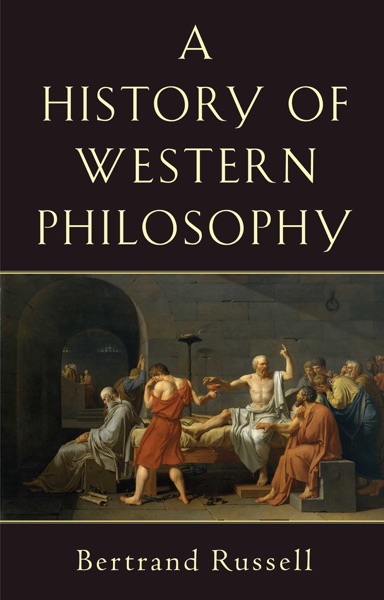
A History of Western Philosophy is Bertrand Russell's single-volume account of Western philosophical thought from the pre-Socratics through Aristotle, the Stoics, medieval Scholasticism, the Renaissance, the empiricists and rationalists, Kant, German Idealism, and the nineteenth and early twentieth centuries.
Bertrand Russell · 1945 · 18h 45m
Full summary and key takeaways →The 12 questions
- 1.
Russell writes with strong opinions about nearly every philosopher. Does his argumentativeness make the book more or less useful as an introduction — and does it affect how you receive the philosophers he's hostile to?
- 2.
The book argues that philosophy must be understood in its social and political context. Can you think of philosophical ideas you've encountered whose historical context significantly changed their meaning for you?
- 3.
Russell is deeply sympathetic to the empiricists and deeply hostile to the German Idealists. Is this a principled philosophical position or a cultural and political one — and can you separate them?
- 4.
Hume concluded that inductive reasoning cannot be rationally justified — we have no logical basis for assuming the future will resemble the past. Does this argument still trouble you, or have you found a response that satisfies you?
- 5.
Russell suggests Plato's thought contains the seeds of authoritarianism. Having read some Plato, do you find this reading fair, or does it miss something important about what Plato was trying to do?
- 6.
The book was partly written to defend liberal democracy against fascism in the 1940s. Does knowing that purpose change how you read its judgments about philosophers like Nietzsche and Hegel?
- 7.
Medieval Scholasticism takes up a large portion of the book and gets relatively little sympathy from Russell. What, if anything, does the period contribute to philosophy — or was Russell right to treat it as a long detour?
- 8.
If you had to identify the single question that runs through the entire history of Western philosophy as Russell tells it, what would you say it is?
- 9.
Russell himself believed that logic and mathematics provided the model for philosophical clarity. Does his own philosophical work — the theory of types, logical atomism — seem to bear that out?
- 10.
Is it possible to write a genuinely neutral history of philosophy, or does any such project inevitably reflect its author's philosophical commitments? What would be gained or lost by greater neutrality?
- 11.
Which philosopher in the book do you find most interesting or alive — and does Russell's treatment help or hinder your engagement with them?
- 12.
The book ends with James and Dewey and early analytic philosophy — Russell's own tradition. Does the narrative feel like it has been driving toward that conclusion all along?
How to run the discussion
- Pick six to eight, not all of them. An hour of real discussion covers fewer questions than anyone expects, and racing the list is what makes a book club feel like homework.
- Open with what people noticed, not what they concluded. Asking for a verdict first hardens opinions before anyone has heard each other.
- Let the disagreement run. The questions below that split a room are the ones worth the time; the ones everyone answers the same way can be skipped.
- Ask the quiet person a specific question. A direct, narrow question is far easier to answer than an open invitation to contribute.
Themes worth steering toward
If the conversation stalls, these are the threads that usually restart it.
Common questions
What are good book club questions for A History of Western Philosophy?
Here are 12 book club questions for A History of Western Philosophy by Bertrand Russell, ordered to open easily and end somewhere worth arguing about. The strongest openers ask what each reader noticed rather than what they concluded, and the discussion usually turns on philosophy and history, reason and religion, political thought.
How long should a book club discussion of A History of Western Philosophy last?
Most groups run 60 to 90 minutes of actual discussion. That is roughly six to eight questions, not all of them, so pick the ones that suit your group rather than working down the list in order.
What are the main themes in A History of Western Philosophy?
Philosophy and history, Reason and religion, Political thought, Science and metaphysics, Intellectual biography. Those are the threads most likely to divide a room, which makes them the useful places to steer a discussion that has gone quiet.
Picking the next one? See books like A History of Western Philosophy or questions for other book club picks.
