Fantasy · Book club
A Little Hatred book club questions
Here are 12 book club questions for A Little Hatred by Joe Abercrombie, ordered to open easily and end somewhere worth arguing about. Copy them, print them, or bring them up one at a time.
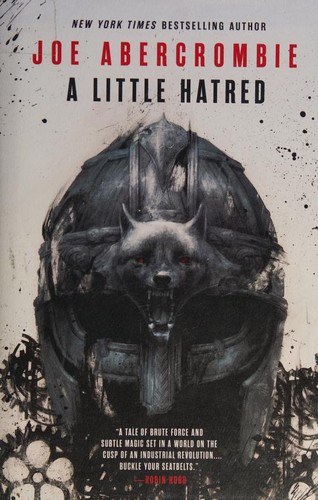
A Little Hatred is the first book in Abercrombie's The Age of Madness trilogy, set in the same world as his First Law trilogy but a generation later.
Joe Abercrombie · 2019 · 12h 15m
Full summary and key takeaways →The 12 questions
- 1.
Savine dan Glokta is the novel's most morally complex figure. Is she a villain, a pragmatist, or something else? Does the novel want you to like her?
- 2.
The Breakers are revolutionary agitators with legitimate grievances. Does Abercrombie make their cause sympathetic, or does he undermine it? What's his political position, do you think?
- 3.
Leo dan Brock is brave and admired and makes catastrophically bad decisions. Is the novel arguing that heroism and good judgment are simply different skills, or is it making a harsher point?
- 4.
The industrial revolution setting is unusual for fantasy. Did it work for you? Does it clarify or reduce the political arguments by making them this legible?
- 5.
The Circle of the World has a history of violent upheaval. Does the novel suggest that the current crisis is meaningfully different from the last one, or just another cycle?
- 6.
Rikke sees the future but can't change it in obvious ways. Is her power a gift or a curse — and does the novel take a position on that?
- 7.
How does this compare to the First Law trilogy's mood? Abercrombie seems angrier here, or at least more politically specific. Do you read it that way?
- 8.
The aristocratic characters — Savine, Leo, Orso — are all more sympathetic than their class interests would suggest. Is that a problem, or is it part of the point?
- 9.
The ending sets up the next two books aggressively. Did that feel satisfying as a standalone experience, or did it feel like a setup document?
- 10.
Abercrombie has talked about wanting to write about how people in power justify their self-interest with principle. Which character in this book does that most clearly?
- 11.
The Breakers are compared to Chartists, trade unionists, even early socialists. Does that mapping feel accurate? What does it gain or lose by being in a fantasy world?
- 12.
Violence in the novel is often followed by its consequences being shown in detail. Does that make the action sequences feel more or less exciting than standard fantasy?
How to run the discussion
- Pick six to eight, not all of them. An hour of real discussion covers fewer questions than anyone expects, and racing the list is what makes a book club feel like homework.
- Open with what people noticed, not what they concluded. Asking for a verdict first hardens opinions before anyone has heard each other.
- Let the disagreement run. The questions below that split a room are the ones worth the time; the ones everyone answers the same way can be skipped.
- Ask the quiet person a specific question. A direct, narrow question is far easier to answer than an open invitation to contribute.
Themes worth steering toward
If the conversation stalls, these are the threads that usually restart it.
Common questions
What are good book club questions for A Little Hatred?
Here are 12 book club questions for A Little Hatred by Joe Abercrombie, ordered to open easily and end somewhere worth arguing about. The strongest openers ask what each reader noticed rather than what they concluded, and the discussion usually turns on industrialization and its human cost, class conflict, cynicism and idealism.
How long should a book club discussion of A Little Hatred last?
Most groups run 60 to 90 minutes of actual discussion. That is roughly six to eight questions, not all of them, so pick the ones that suit your group rather than working down the list in order.
What are the main themes in A Little Hatred?
Industrialization and its human cost, Class conflict, Cynicism and idealism, Violence and consequence, Inheritance and legacy. Those are the threads most likely to divide a room, which makes them the useful places to steer a discussion that has gone quiet.
Picking the next one? See books like A Little Hatred or questions for other book club picks.
