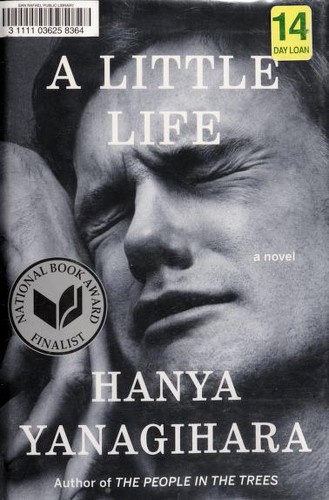
A Little Life by Hanya Yanagihara is a 2015 literary fiction book about trauma and its persistence, male friendship, survival and its costs. The novel refuses the narrative of recovery — Jude's trauma is not resolved by love, therapy, friendship, or success, which is either its deepest honesty or its deepest manipulation, depending on your reading.
Summary
A Little Life follows four men from college into middle age and beyond — Willem, an actor; JB, a painter; Malcolm, an architect; and Jude, a lawyer with a past that is revealed in increasingly devastating detail as the novel progresses. The four are close in their twenties, and the novel is partly a portrait of a deep male friendship network. But the novel's true subject is Jude and what he carries: a childhood of abuse so severe and prolonged that the full picture takes hundreds of pages to emerge, and which has left him unable to believe he deserves to live.
Yanagihara is doing something extreme and deliberate with the accumulation of Jude's suffering. The novel has been criticized for piling on trauma beyond what any reader (or plausible life) can absorb, and that criticism is fair in a narrow sense. What the novel is asking is a harder question: what does it mean to love someone whose damage is so profound that love alone — any love, all the love his friends and later his adoptive father Harold pour into him — cannot repair it? Jude does not get better, not in the way readers accustomed to therapeutic narratives expect.
The prose is deliberately flat and relentless — Yanagihara avoids beautiful sentences in the McCarthy or Ondaatje mode. The effect is of documentary accumulation: these things happened; these things kept happening. The novel's geography is unspecified and timeless (no smartphones, no contemporary signifiers), which makes it feel like fable or myth. At roughly 700,000 words it is genuinely enormous, and the relationship between the reader's investment and the suffering Yanagihara deploys becomes its own uncomfortable subject.
A Little Life is the most divisive major literary novel of the 2010s. Its admirers, often fiercely passionate, find it one of the most honest depictions of trauma's persistence and friendship's reach ever written. Its detractors find the suffering pornographic — a manipulation of the reader's empathy rather than an artistic act. Both responses are sincere and both are engaging with something real in the text. Whatever you think of it, you will not be neutral.
Talk to A Little Life like its author wrote you back.
Get the ideas that fit your life — not generic summaries.
- Chat with the book
- Audiobook-style main ideas
- Adapts to your life and goals
- Helps you take action
Key takeaways
- 1.
The novel refuses the narrative of recovery — Jude's trauma is not resolved by love, therapy, friendship, or success, which is either its deepest honesty or its deepest manipulation, depending on your reading.
- 2.
Male friendship — its intensity, its physical tenderness, its capacity for care — is presented with a specificity that is rare in literary fiction, and not sentimentalized.
- 3.
The novel's accumulation of trauma has a formal purpose: it is asking whether there is a quantity of damage that love cannot repair, and giving you the evidence for its answer.
- 4.
Willem's love for Jude, and Harold's adoptive parenting of him, are the novel's counter-forces — genuine, sustained, and ultimately inadequate. That inadequacy is not presented as failure.
- 5.
Self-harm is depicted throughout with clinical specificity. Yanagihara is not using it as metaphor; she insists on it as a physical reality with its own logic.
- 6.
The novel's timeline is long and compressed simultaneously — decades pass quickly in some sections, moments of crisis stretch across hundreds of pages. Time in A Little Life is distorted by trauma.
- 7.
JB and Malcolm are less central than Willem and Jude, but they represent the ways adult friendship drifts and survives — more like observation points on a life than fully developed characters.
- 8.
The ending is devastating and, depending on how you read the preceding 700 pages, either the only honest conclusion or an act of authorial cruelty. The debate is not settled.
Discussion questions
Use these on your own, with a book club, or as chat starters in Superbook. Book club version, ready to copy or print →
- 1.
Yanagihara said she wanted to write about the 'inexorable progress of misery.' Did you feel the novel achieved that honestly, or did it tip into exploitation?
- 2.
Jude refuses, for most of the novel, to tell his friends what happened to him. How do you understand that refusal — as protection, as shame, as something else?
- 3.
The novel's setting is deliberately timeless and unspecific. What does that choice do to how the story reads — does it feel universal or unmoored?
- 4.
Willem chooses, very late in the novel, to become Jude's partner. Do you read that as love finally legible, or as another form of care that can't ultimately succeed?
- 5.
Harold's adoption of Jude is one of the novel's central acts of love. What does it give Jude, and what can't it give him?
- 6.
The novel has been criticized for 'torture porn' — deploying suffering for emotional effect without sufficient moral purpose. Do you think that criticism is fair?
- 7.
Jude's self-harm is depicted in sustained physical detail. What is Yanagihara doing with that level of specificity?
- 8.
The novel is about four men, and male friendship and male touch are depicted with unusual tenderness. Does the novel have anything interesting to say about masculinity, or is that not really its subject?
- 9.
By the end of the novel, are you glad you read it? That's not a rhetorical question — readers answer very differently, and the reason they do is revealing.
- 10.
The friendship between the four men drifts and changes over decades in ways that feel very true. Which of those shifts resonated most with your own experience of long friendships?
- 11.
The novel refuses to give Jude a backstory that makes psychological sense — his abuse is too extreme and too prolonged to be plausible. Is that a flaw or a feature?
- 12.
Compared to The Road — another novel about extreme suffering and love — what does each book ask of its reader that the other doesn't?
Themes
Frequently asked questions
-
Is A Little Life worth reading?
That depends more on what you're looking for than almost any other contemporary novel. It is extraordinary on male friendship, on the texture of adult life, and on the persistence of childhood trauma. It is also relentlessly brutal. Many readers find it one of the most affecting books they've ever read; others find it an endurance test they'd rather not repeat.
-
How long is A Little Life to read?
At roughly 720,000 words it's one of the longest contemporary literary novels in English — comparable to a long Tolstoy. At 250 words per minute that's roughly 48 hours of reading, though most readers spread it over weeks. It is not a book you can read in a weekend.
-
Is A Little Life too dark to read?
Possibly, depending on your current mental state and history. The novel contains extensive depictions of child abuse, self-harm, and suicide. If those subjects are live for you personally, be cautious. Many readers find that the depth of care and friendship in the novel makes the darkness bearable; others do not.
-
Why is A Little Life so divisive?
Because it deploys suffering in quantities that test the reader's tolerance, without offering the narrative of recovery that usually accompanies literary treatment of trauma. Whether that is artistically honest or emotionally manipulative is a genuine debate, and both sides have real arguments.
-
Who shouldn't read A Little Life?
Anyone for whom detailed depictions of child sexual abuse, self-harm, or suicide are genuinely harmful rather than just distressing. Also anyone who needs resolution: the novel doesn't give it. If you read fiction primarily for hope, this book will break that contract.