Memoir · Book club
A Man for All Markets book club questions
Here are 12 book club questions for A Man for All Markets by Edward O. Thorp, ordered to open easily and end somewhere worth arguing about. Copy them, print them, or bring them up one at a time.
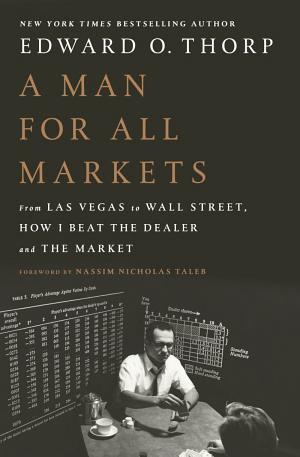
A Man for All Markets is Edward Thorp's memoir of a life spent finding mathematical edges — first in casinos and later in financial markets.
Edward O. Thorp · 2017 · 6h 45m
Full summary and key takeaways →The 12 questions
- 1.
Thorp applied the same framework to blackjack and to financial markets. What is that framework, and how transferable do you think it is to contexts outside mathematics?
- 2.
The Kelly criterion gives you the mathematically optimal bet size. What makes it hard to follow in practice, even when you believe you have an edge?
- 3.
Thorp identified Madoff as fraudulent years before the scandal broke and chose not to invest but also not to report him publicly. How do you think about that decision?
- 4.
The casinos eventually changed their rules when Thorp's edge was too well-known. How do financial markets do the same thing — eliminate edges once they're widely discovered?
- 5.
Thorp comes from academic mathematics rather than finance. How does that background shape his approach differently from someone trained in traditional investing?
- 6.
The memoir describes Princeton-Newport Partners being targeted in a government investigation that Thorp believed was motivated by an unrelated prosecution. How did that experience shape his views on the relationship between wealth, law, and institutional power?
- 7.
Thorp is unusually candid about his mistakes and his uncertainties alongside his successes. How does that quality affect your reception of his claims about what worked?
- 8.
The book covers five decades of financial and casino markets. What surprised you most about how markets or gambling operations worked in earlier eras compared to today?
- 9.
Thorp's edge in blackjack came from information the casino didn't properly account for. What are the analogous information edges in today's financial markets, and who holds them?
- 10.
Thorp describes building significant wealth through rigorous mathematical work. How does his story compare to the conventional narratives about how wealth is built in America?
- 11.
The second half of the book addresses how Thorp managed his personal finances and what he learned about wealth. What was the most surprising or useful observation from that section?
- 12.
Thorp says the Kelly criterion is nearly universally ignored by professional investors despite its theoretical optimality. Why do you think that is?
How to run the discussion
- Pick six to eight, not all of them. An hour of real discussion covers fewer questions than anyone expects, and racing the list is what makes a book club feel like homework.
- Open with what people noticed, not what they concluded. Asking for a verdict first hardens opinions before anyone has heard each other.
- Let the disagreement run. The questions below that split a room are the ones worth the time; the ones everyone answers the same way can be skipped.
- Ask the quiet person a specific question. A direct, narrow question is far easier to answer than an open invitation to contribute.
Themes worth steering toward
If the conversation stalls, these are the threads that usually restart it.
Common questions
What are good book club questions for A Man for All Markets?
Here are 12 book club questions for A Man for All Markets by Edward O. Thorp, ordered to open easily and end somewhere worth arguing about. The strongest openers ask what each reader noticed rather than what they concluded, and the discussion usually turns on quantitative investing, probability, gambling.
How long should a book club discussion of A Man for All Markets last?
Most groups run 60 to 90 minutes of actual discussion. That is roughly six to eight questions, not all of them, so pick the ones that suit your group rather than working down the list in order.
What are the main themes in A Man for All Markets?
Quantitative investing, Probability, Gambling, Hedge funds, Mathematical thinking. Those are the threads most likely to divide a room, which makes them the useful places to steer a discussion that has gone quiet.
Picking the next one? See books like A Man for All Markets or questions for other book club picks.
