History · Book club
A Man on the Moon book club questions
Here are 12 book club questions for A Man on the Moon by Andrew Chaikin, ordered to open easily and end somewhere worth arguing about. Copy them, print them, or bring them up one at a time.
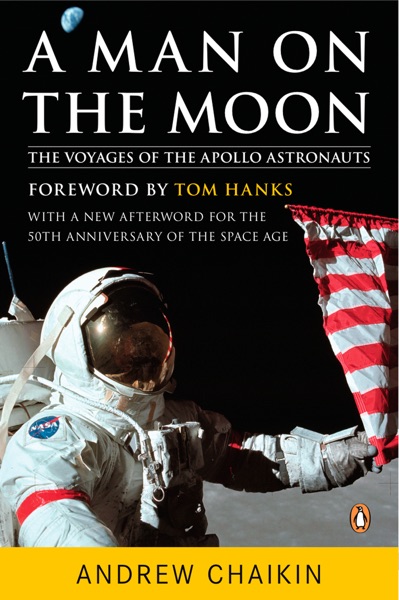
A Man on the Moon is Andrew Chaikin's exhaustive narrative history of the Apollo program, from the first lunar orbit of Apollo 8 in 1968 through the final mission, Apollo 17, in 1972.
Andrew Chaikin · 1994 · 12h 0m
Full summary and key takeaways →The 12 questions
- 1.
Chaikin based the book on interviews with all surviving Apollo astronauts. How does first-person testimony change the texture of this kind of history, and what does it risk missing?
- 2.
The Apollo 1 fire killed three astronauts and forced NASA to redesign its management culture. What do you think changed most fundamentally after that accident, and did it last?
- 3.
Neil Armstrong's precise, private personality is portrayed sympathetically. What does it suggest about the relationship between competence and public communication — do we sometimes misread reticence as arrogance?
- 4.
Many astronauts struggled to find purpose after the Moon landings. What does that suggest about the relationship between peak achievement and subsequent motivation?
- 5.
The book describes NASA making explicit calculations about risk levels that would have been unacceptable if publicly discussed. How do you think about organizational decisions that depend on not sharing the full calculus with the people taking the risk?
- 6.
Apollo 13 is the most dramatic mission in the book because it failed technically. What does the mission's resolution tell you about the conditions that produce extraordinary problem-solving?
- 7.
The later Apollo missions — 15, 16, 17 — were scientifically far more ambitious than the early ones but drew much smaller public audiences. Why do you think that is, and what does it say about how we relate to ongoing achievement versus first achievement?
- 8.
The command module pilots orbited alone while their crewmates walked below them. Michael Collins called the experience both lonely and satisfying. What does it reveal about personality that some people found it meaningful and others found it difficult?
- 9.
Apollo ended in 1972 and humans have not returned to the Moon since. How do you explain that half-century gap, and what would it take to close it?
- 10.
Chaikin is balanced about NASA's failures and management problems. Does knowing that the program had serious institutional problems change your view of its achievements?
- 11.
The book covers twelve missions across roughly five years. Which mission or astronaut portrait do you find most illuminating, and why?
- 12.
The Apollo program cost roughly $25 billion in 1960s dollars. Was it worth it? On what grounds would you argue yes or no?
How to run the discussion
- Pick six to eight, not all of them. An hour of real discussion covers fewer questions than anyone expects, and racing the list is what makes a book club feel like homework.
- Open with what people noticed, not what they concluded. Asking for a verdict first hardens opinions before anyone has heard each other.
- Let the disagreement run. The questions below that split a room are the ones worth the time; the ones everyone answers the same way can be skipped.
- Ask the quiet person a specific question. A direct, narrow question is far easier to answer than an open invitation to contribute.
Themes worth steering toward
If the conversation stalls, these are the threads that usually restart it.
Common questions
What are good book club questions for A Man on the Moon?
Here are 12 book club questions for A Man on the Moon by Andrew Chaikin, ordered to open easily and end somewhere worth arguing about. The strongest openers ask what each reader noticed rather than what they concluded, and the discussion usually turns on space exploration, apollo program, human achievement.
How long should a book club discussion of A Man on the Moon last?
Most groups run 60 to 90 minutes of actual discussion. That is roughly six to eight questions, not all of them, so pick the ones that suit your group rather than working down the list in order.
What are the main themes in A Man on the Moon?
Space exploration, Apollo program, Human achievement, Science and technology, Courage. Those are the threads most likely to divide a room, which makes them the useful places to steer a discussion that has gone quiet.
Picking the next one? See books like A Man on the Moon or questions for other book club picks.
