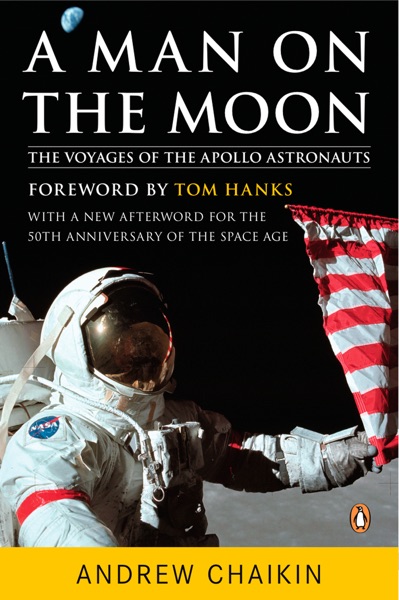
A Man on the Moon by Andrew Chaikin is a 1994 history book about space exploration, apollo program, human achievement. The Apollo program involved thousands of engineers and technicians working on an impossibly tight schedule after the Apollo 1 fire. The success was a collective engineering achievement, not just an astronaut achievement.
Summary
A Man on the Moon is Andrew Chaikin's exhaustive narrative history of the Apollo program, from the first lunar orbit of Apollo 8 in 1968 through the final mission, Apollo 17, in 1972. Based on interviews with all twenty-three surviving astronauts who flew to the Moon — conducted over five years — it is the most comprehensive and authoritative account of what those missions actually felt like from the inside. When the HBO miniseries From the Earth to the Moon aired in 1998, this book was its primary source.
Chaikin's achievement is to make the technical accessible without simplifying it, and to make the emotional real without sentimentalizing it. He is meticulous about the engineering decisions, navigational challenges, and near-disasters of each mission — the oxygen tank explosion on Apollo 13 is described in the kind of minute-by-minute detail that makes it physically tense to read, even for readers who know the outcome. But he is equally attentive to the interior lives of the astronauts: the pressure of selection, the grief when colleagues died in the Apollo 1 fire, the strange solitude of command module pilots who orbited the Moon while their crewmates walked on it, the difficulty of returning to ordinary life after having been somewhere no human had ever been.
The book does not romanticize NASA. It describes internal politics, the pressure of schedule that may have contributed to preventable deaths, and the ways in which mission success sometimes papered over management problems that needed fixing. The portraits of individual astronauts are specific enough to be usefully different from one another: Neil Armstrong's famous reticence is treated as a genuine personality trait, not a pose; Buzz Aldrin's ambition and emotional complexity are handled with sympathy; Dave Scott's intellectual precision is contrasted with the more instinctive approach of other commanders.
For readers who lived through the Apollo era, the book is a more complete account than they could have gotten from contemporary reporting. For those who came afterward, it is a necessary corrective to the mythology that surrounds Apollo — neither dismissing the achievement nor treating the astronauts as figures rather than people. It remains the definitive popular history of the most demanding and consequential engineering project of the twentieth century.
Talk to A Man on the Moon like its author wrote you back.
Get the ideas that fit your life — not generic summaries.
- Chat with the book
- Audiobook-style main ideas
- Adapts to your life and goals
- Helps you take action
Key takeaways
- 1.
The Apollo program involved thousands of engineers and technicians working on an impossibly tight schedule after the Apollo 1 fire. The success was a collective engineering achievement, not just an astronaut achievement.
- 2.
Apollo 13 demonstrated that crisis management under genuine time pressure and uncertainty can produce extraordinary results. The mission's failure became its most celebrated success.
- 3.
Neil Armstrong's character — precise, private, profoundly competent — shaped how Apollo 11 was experienced and remembered. His famous reluctance to talk about the Moon landing was consistent with who he was, not strategic.
- 4.
The astronauts who walked on the Moon were selected for a combination of engineering competence, physical performance, psychological stability, and political acceptability that was genuinely rare. The selection process itself is one of the book's most interesting stories.
- 5.
Many Apollo astronauts experienced significant psychological difficulty after returning from the Moon — not because the missions failed but because no subsequent challenge could match the intensity of what they had done.
- 6.
The command module pilots who orbited the Moon while crewmates landed are an underappreciated part of the story. Their technical role was critical; their emotional experience of being the most isolated humans in history is remarkable.
- 7.
The Apollo program required a culture of calculated risk-taking that was explicit and deliberate. The deaths in Apollo 1 forced NASA to reckon with how it managed risk, and the management changes that followed were directly responsible for subsequent mission successes.
- 8.
The scientific return of the later Apollo missions (12-17) was substantial and is underappreciated. Geologist Harrison Schmitt on Apollo 17 represents what the program could have continued producing had funding continued.
Discussion questions
Use these on your own, with a book club, or as chat starters in Superbook. Book club version, ready to copy or print →
- 1.
Chaikin based the book on interviews with all surviving Apollo astronauts. How does first-person testimony change the texture of this kind of history, and what does it risk missing?
- 2.
The Apollo 1 fire killed three astronauts and forced NASA to redesign its management culture. What do you think changed most fundamentally after that accident, and did it last?
- 3.
Neil Armstrong's precise, private personality is portrayed sympathetically. What does it suggest about the relationship between competence and public communication — do we sometimes misread reticence as arrogance?
- 4.
Many astronauts struggled to find purpose after the Moon landings. What does that suggest about the relationship between peak achievement and subsequent motivation?
- 5.
The book describes NASA making explicit calculations about risk levels that would have been unacceptable if publicly discussed. How do you think about organizational decisions that depend on not sharing the full calculus with the people taking the risk?
- 6.
Apollo 13 is the most dramatic mission in the book because it failed technically. What does the mission's resolution tell you about the conditions that produce extraordinary problem-solving?
- 7.
The later Apollo missions — 15, 16, 17 — were scientifically far more ambitious than the early ones but drew much smaller public audiences. Why do you think that is, and what does it say about how we relate to ongoing achievement versus first achievement?
- 8.
The command module pilots orbited alone while their crewmates walked below them. Michael Collins called the experience both lonely and satisfying. What does it reveal about personality that some people found it meaningful and others found it difficult?
- 9.
Apollo ended in 1972 and humans have not returned to the Moon since. How do you explain that half-century gap, and what would it take to close it?
- 10.
Chaikin is balanced about NASA's failures and management problems. Does knowing that the program had serious institutional problems change your view of its achievements?
- 11.
The book covers twelve missions across roughly five years. Which mission or astronaut portrait do you find most illuminating, and why?
- 12.
The Apollo program cost roughly $25 billion in 1960s dollars. Was it worth it? On what grounds would you argue yes or no?
Themes
Frequently asked questions
-
Is A Man on the Moon worth reading even if you've seen the HBO miniseries?
Yes — the book has more depth, more technical detail, and more of each astronaut's inner life than any television adaptation could carry. The HBO series is excellent, but it drew on Chaikin's interviews selectively. The book is the complete account.
-
How long is A Man on the Moon?
Around 670 pages. At average reading pace, 12 to 14 hours. Each mission gets a chapter or more, so the book can be read in sections. The Apollo 13 and Apollo 11 chapters are the most frequently excerpted and can stand alone.
-
Do you need prior knowledge of the space program to read this book?
No. Chaikin explains the technical background as he goes, and the narrative structure means you can follow it without any prior knowledge. Readers with prior interest in spaceflight will get more out of the technical detail, but it's not a prerequisite.
-
What makes this the definitive Apollo book?
The scope of interviews: Chaikin spoke to all surviving astronauts before several of them died. No subsequent account had that access. Combined with his technical accuracy and his ability to render interior experience in readable prose, it set a standard that hasn't been matched.
-
Is there anything the book gets wrong or leaves out?
The book focuses almost entirely on the astronauts and flight operations. The engineers, mission control staff, and administrators who made Apollo possible get less individual attention. Norman Mailer's Of a Fire on the Moon offers a different angle as a contemporary observer; together, the books give a fuller picture.