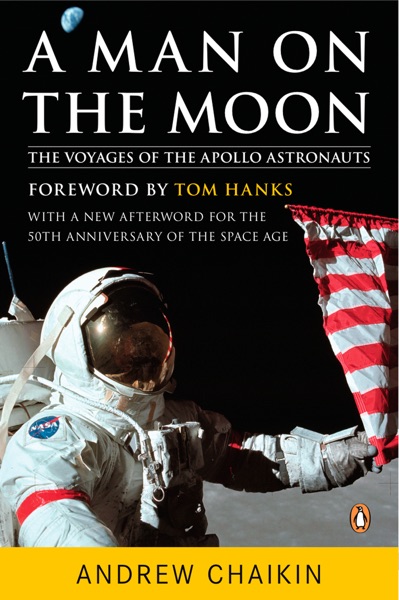
Talk to A Man on the Moon like its author wrote you back.
Get the ideas that fit your life — not generic summaries.
- Chat with the book
- Audiobook-style main ideas
- Adapts to your life and goals
- Helps you take action
What it argues
A Man on the Moon is Andrew Chaikin's exhaustive narrative history of the Apollo program, from the first lunar orbit of Apollo 8 in 1968 through the final mission, Apollo 17, in 1972. Based on interviews with all twenty-three surviving astronauts who flew to the Moon — conducted over five years — it is the most comprehensive and authoritative account of what those missions actually felt like from the inside. When the HBO miniseries From the Earth to the Moon aired in 1998, this book was its primary source.
Chaikin's achievement is to make the technical accessible without simplifying it, and to make the emotional real without sentimentalizing it. He is meticulous about the engineering decisions, navigational challenges, and near-disasters of each mission — the oxygen tank explosion on Apollo 13 is described in the kind of minute-by-minute detail that makes it physically tense to read, even for readers who know the outcome. But he is equally attentive to the interior lives of the astronauts: the pressure of selection, the grief when colleagues died in the Apollo 1 fire, the strange solitude of command module pilots who orbited the Moon while their crewmates walked on it, the difficulty of returning to ordinary life after having been somewhere no human had ever been.
What it gets right
- 1.
The Apollo program involved thousands of engineers and technicians working on an impossibly tight schedule after the Apollo 1 fire. The success was a collective engineering achievement, not just an astronaut achievement.
- 2.
Apollo 13 demonstrated that crisis management under genuine time pressure and uncertainty can produce extraordinary results. The mission's failure became its most celebrated success.
- 3.
Neil Armstrong's character — precise, private, profoundly competent — shaped how Apollo 11 was experienced and remembered. His famous reluctance to talk about the Moon landing was consistent with who he was, not strategic.
What it covers
Who wrote it
Andrew Chaikin is an American science journalist and author who spent five years conducting the interviews that form the backbone of A Man on the Moon. He has written and contributed to numerous other space science projects, including the HBO miniseries From the Earth to the Moon (1998), for which this book was the primary source. He has lectured widely on spaceflight and planetary science and has been involved in NASA mission public outreach. A Man on the Moon, published in 1994, is widely considered the definitive popular history of the Apollo program.
