Self-help · Book club
A Mind for Numbers book club questions
Here are 11 book club questions for A Mind for Numbers by Barbara Oakley, ordered to open easily and end somewhere worth arguing about. Copy them, print them, or bring them up one at a time.
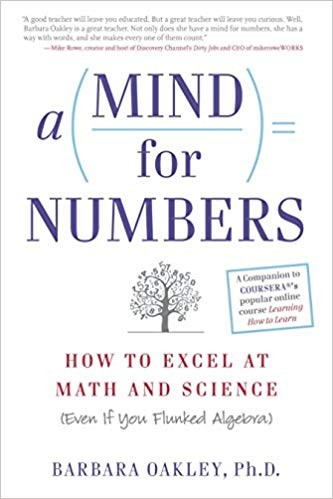
A Mind for Numbers is Barbara Oakley's guide to learning hard subjects effectively, written primarily for students struggling with mathematics and science but drawing on cognitive science principles that apply to any demanding field.
Barbara Oakley · 2014 · 4h 20m
Full summary and key takeaways →The 11 questions
- 1.
Oakley spent years believing she couldn't do math, then rebuilt her abilities from scratch. What subjects or skills have you written off for yourself that might be more learnable than you believe?
- 2.
Think of a time when you stepped away from a hard problem and the solution appeared unexpectedly. Was that diffuse-mode processing? Could you engineer more of that deliberately?
- 3.
Which of your current study or learning practices most relies on re-reading and review rather than active recall? What would replacing it with testing look like?
- 4.
Oakley's treatment of procrastination reframes it as pain avoidance rather than laziness. Does that change how you think about your own avoidance patterns?
- 5.
When have you most vividly experienced the illusion of competence — felt fluent about something you turned out not to really know? What revealed the gap?
- 6.
She recommends the Pomodoro technique specifically as a tool for starting. Have you tried it? If not, what stops you from running a one-week experiment?
- 7.
What is the most important subject you're currently trying to learn? Which of the techniques in the book — spaced repetition, interleaving, active recall — is most absent from your current approach?
- 8.
Oakley writes about her transition from math-avoider to engineer. What does her story suggest about the relationship between self-narrative and actual ability?
- 9.
Interleaving feels less efficient and more confusing than blocked practice, but produces better long-term results. Where in your current learning are you defaulting to the comfortable blocked approach?
- 10.
How does sleep figure into your current learning routine? Would you be willing to experiment with making adequate sleep a non-negotiable learning variable for two weeks?
- 11.
The book is aimed at students but applies to professionals. Which ideas translate most directly to how you learn new skills or information in your current work?
How to run the discussion
- Pick six to eight, not all of them. An hour of real discussion covers fewer questions than anyone expects, and racing the list is what makes a book club feel like homework.
- Open with what people noticed, not what they concluded. Asking for a verdict first hardens opinions before anyone has heard each other.
- Let the disagreement run. The questions below that split a room are the ones worth the time; the ones everyone answers the same way can be skipped.
- Ask the quiet person a specific question. A direct, narrow question is far easier to answer than an open invitation to contribute.
Themes worth steering toward
If the conversation stalls, these are the threads that usually restart it.
Common questions
What are good book club questions for A Mind for Numbers?
Here are 11 book club questions for A Mind for Numbers by Barbara Oakley, ordered to open easily and end somewhere worth arguing about. The strongest openers ask what each reader noticed rather than what they concluded, and the discussion usually turns on learning, mathematics, study techniques.
How long should a book club discussion of A Mind for Numbers last?
Most groups run 60 to 90 minutes of actual discussion. That is roughly six to eight questions, not all of them, so pick the ones that suit your group rather than working down the list in order.
What are the main themes in A Mind for Numbers?
Learning, Mathematics, Study techniques, Memory, Brain science. Those are the threads most likely to divide a room, which makes them the useful places to steer a discussion that has gone quiet.
Picking the next one? See books like A Mind for Numbers or questions for other book club picks.
