Science · Book club
A Philosophy of Software Design book club questions
Here are 12 book club questions for A Philosophy of Software Design by John Ousterhout, ordered to open easily and end somewhere worth arguing about. Copy them, print them, or bring them up one at a time.
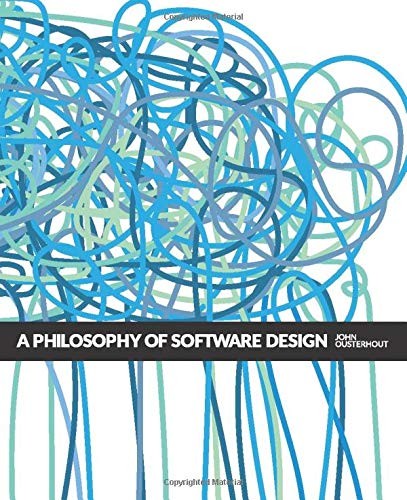
John Ousterhout's central claim in this book is that the greatest limitation in software development is our ability to manage complexity, and that almost every problem in large systems can be traced back to complexity that was unnecessary and could have been prevented.
John Ousterhout · 2018 · 4h 0m
Full summary and key takeaways →The 12 questions
- 1.
Ousterhout says complexity is almost always the result of incremental decisions that each seemed fine. Can you think of a codebase where this has played out, including systems you've worked on?
- 2.
The distinction between deep and shallow modules is appealing in theory. What makes it hard to apply consistently in practice, especially under time pressure?
- 3.
Ousterhout is openly prescriptive — he has strong opinions about comments, error handling, module design. Does that strengthen or weaken the book's usefulness as a reference?
- 4.
The book argues for strategic programming even in early-stage startups. Do you find that convincing? Where does design investment pay off quickly versus when does it genuinely not matter yet?
- 5.
He argues that the best interface is one that makes the common case simple, even if it obscures edge cases. Are there situations where that tradeoff goes wrong?
- 6.
Ousterhout criticizes the convention of writing many short comments. Where do you land on commenting style, and has your view changed after reading this?
- 7.
The book is specifically about systems software. How much of its advice transfers cleanly to application code, frontend development, or data pipelines?
- 8.
Information hiding is the book's core technique. What are situations where hiding information actually creates problems — where the abstraction makes debugging harder or causes surprising failures?
- 9.
Ousterhout's examples are mostly drawn from his own systems work. Would the book's arguments be more or less convincing with a broader range of examples?
- 10.
The book was revised to a second edition fairly quickly after the first. What does it say about a design philosophy book that the author felt the need to refine it?
- 11.
If you were teaching a software design course, which single idea from this book would you put at the center of the syllabus?
- 12.
Ousterhout distinguishes between mistakes that can be fixed gradually versus foundational ones that poison a codebase. How do you identify which type you're dealing with when you inherit existing code?
How to run the discussion
- Pick six to eight, not all of them. An hour of real discussion covers fewer questions than anyone expects, and racing the list is what makes a book club feel like homework.
- Open with what people noticed, not what they concluded. Asking for a verdict first hardens opinions before anyone has heard each other.
- Let the disagreement run. The questions below that split a room are the ones worth the time; the ones everyone answers the same way can be skipped.
- Ask the quiet person a specific question. A direct, narrow question is far easier to answer than an open invitation to contribute.
Themes worth steering toward
If the conversation stalls, these are the threads that usually restart it.
Common questions
What are good book club questions for A Philosophy of Software Design?
Here are 12 book club questions for A Philosophy of Software Design by John Ousterhout, ordered to open easily and end somewhere worth arguing about. The strongest openers ask what each reader noticed rather than what they concluded, and the discussion usually turns on software complexity, system design, programming.
How long should a book club discussion of A Philosophy of Software Design last?
Most groups run 60 to 90 minutes of actual discussion. That is roughly six to eight questions, not all of them, so pick the ones that suit your group rather than working down the list in order.
What are the main themes in A Philosophy of Software Design?
Software complexity, System design, Programming, Engineering judgment, Abstraction. Those are the threads most likely to divide a room, which makes them the useful places to steer a discussion that has gone quiet.
Picking the next one? See books like A Philosophy of Software Design or questions for other book club picks.
