Philosophy · Book club
A Rulebook for Arguments book club questions
Here are 12 book club questions for A Rulebook for Arguments by Anthony Weston, ordered to open easily and end somewhere worth arguing about. Copy them, print them, or bring them up one at a time.
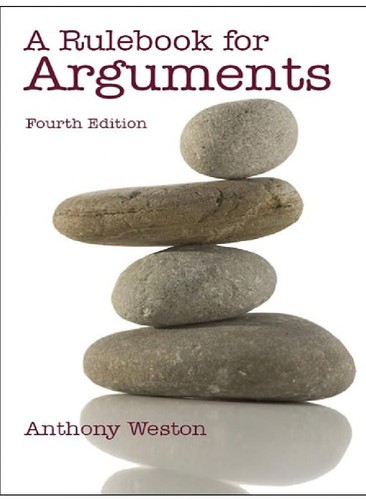
A Rulebook for Arguments is Anthony Weston's slim, widely assigned handbook on how to build and judge arguments.
Anthony Weston · 2009 · 1h 15m
Full summary and key takeaways →The 12 questions
- 1.
Think of a recent disagreement you were in. Were you offering reasons for a conclusion, or just restating your opinion more forcefully?
- 2.
Pick a belief you hold strongly. What are its actual premises, and would someone who disagrees accept them as a starting point?
- 3.
Where do you tend to rely on a single vivid example to make a general claim? What would a fairer sample look like?
- 4.
What analogy do you reach for often in your work? Is the similarity it rests on actually relevant, or just memorable?
- 5.
Whose authority do you cite without checking? How would you know if that source were biased or out of its depth?
- 6.
Recall a time you assumed one thing caused another. Could it have been coincidence, reverse causation, or a shared cause?
- 7.
Where in your own writing does a key word quietly change meaning partway through the argument?
- 8.
When you argue, do you engage the strongest version of the other side, or the easiest one to knock down?
- 9.
Which fallacy do you most often catch yourself committing under pressure, and what tends to trigger it?
- 10.
Weston favors concrete and concise over impressive. Where does your writing lean on loaded language instead of substance?
- 11.
How do you usually handle a real objection to your view: address it head on, or hope no one raises it?
- 12.
If you had to defend a position you disagree with using Weston's rules, what would the most honest version of that case be?
How to run the discussion
- Pick six to eight, not all of them. An hour of real discussion covers fewer questions than anyone expects, and racing the list is what makes a book club feel like homework.
- Open with what people noticed, not what they concluded. Asking for a verdict first hardens opinions before anyone has heard each other.
- Let the disagreement run. The questions below that split a room are the ones worth the time; the ones everyone answers the same way can be skipped.
- Ask the quiet person a specific question. A direct, narrow question is far easier to answer than an open invitation to contribute.
Themes worth steering toward
If the conversation stalls, these are the threads that usually restart it.
Common questions
What are good book club questions for A Rulebook for Arguments?
Here are 12 book club questions for A Rulebook for Arguments by Anthony Weston, ordered to open easily and end somewhere worth arguing about. The strongest openers ask what each reader noticed rather than what they concluded, and the discussion usually turns on critical thinking, logic, argumentation.
How long should a book club discussion of A Rulebook for Arguments last?
Most groups run 60 to 90 minutes of actual discussion. That is roughly six to eight questions, not all of them, so pick the ones that suit your group rather than working down the list in order.
What are the main themes in A Rulebook for Arguments?
Critical thinking, Logic, Argumentation, Rhetoric, Reasoning. Those are the threads most likely to divide a room, which makes them the useful places to steer a discussion that has gone quiet.
Picking the next one? See books like A Rulebook for Arguments or questions for other book club picks.
