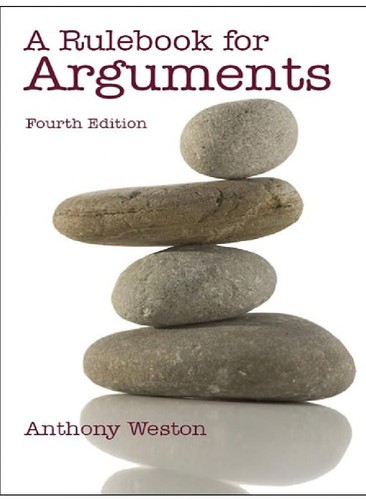
A Rulebook for Arguments by Anthony Weston is a 2009 philosophy book about critical thinking, logic, argumentation. An argument is not a quarrel. It is a set of reasons or evidence offered to support a conclusion, meant to back up an opinion rather than just assert it more loudly.
Summary
A Rulebook for Arguments is Anthony Weston's slim, widely assigned handbook on how to build and judge arguments. It is deliberately not a treatise. Weston treats an argument not as a quarrel but as a set of reasons or evidence offered in support of a conclusion, and he organizes the whole book as a series of short, numbered rules you apply rather than theory you have to absorb.
The heart of the book is its rules for short arguments. Identify your premises and your conclusion, present your points in a natural order, start from reliable premises, and stay concrete and concise. Use consistent terms and hold each term to one meaning, and argue from substance rather than emotional overtone or loaded language. From there Weston works through the main argument types: generalizing from examples, reasoning by analogy, citing authorities and sources, and arguing about causes. Each comes with its own cautions, like needing enough representative examples, analogies that are relevant rather than merely catchy, sources that are informed and unbiased, and correlation that is not mistaken for cause.
Later chapters move to deductive arguments, laying out the classic valid forms in plain language: modus ponens, modus tollens, hypothetical syllogism, disjunctive syllogism, dilemma, and reductio ad absurdum. Weston then shows how to assemble these pieces into an argumentative essay, exploring the question first, defending a main point, meeting objections, and weighing alternatives. A closing reference lists the common fallacies, from ad hominem and straw man to false cause and begging the question, so you can name the mistakes in other people's reasoning and your own.
The brevity is the point. This is a reference you return to while writing or testing a claim, not a text you read once and shelve. That also marks its limit. It is a primer on the mechanics of good argument, not a deep course in formal logic or rhetoric, and it assumes you supply the subject knowledge yourself. As a fast, practical checklist for thinking and writing more clearly, though, it has few equals, which is why it has stayed in print and on syllabi for decades.
Talk to A Rulebook for Arguments like its author wrote you back.
Get the ideas that fit your life — not generic summaries.
- Chat with the book
- Audiobook-style main ideas
- Adapts to your life and goals
- Helps you take action
Key takeaways
- 1.
An argument is not a quarrel. It is a set of reasons or evidence offered to support a conclusion, meant to back up an opinion rather than just assert it more loudly.
- 2.
Start from reliable premises. Even a perfectly structured argument fails if it rests on premises the reader won't grant.
- 3.
Use consistent terms and hold each term to a single meaning, so the argument doesn't quietly shift ground as it goes.
- 4.
Generalizing from examples needs enough of them, representative ones, and honest attention to the counterexamples.
- 5.
Arguments by analogy stand or fall on relevant similarity between the two cases, not surface resemblance.
- 6.
Appeals to authority work only when the source is genuinely informed, unbiased, and citable, not merely confident or famous.
- 7.
Correlation is not cause. Before claiming X causes Y, rule out coincidence, reverse causation, and a shared third cause.
- 8.
Learn the valid deductive forms, like modus ponens and modus tollens, so you can both build tight arguments and spot where others' arguments break.
Discussion questions
Use these on your own, with a book club, or as chat starters in Superbook. Book club version, ready to copy or print →
- 1.
Think of a recent disagreement you were in. Were you offering reasons for a conclusion, or just restating your opinion more forcefully?
- 2.
Pick a belief you hold strongly. What are its actual premises, and would someone who disagrees accept them as a starting point?
- 3.
Where do you tend to rely on a single vivid example to make a general claim? What would a fairer sample look like?
- 4.
What analogy do you reach for often in your work? Is the similarity it rests on actually relevant, or just memorable?
- 5.
Whose authority do you cite without checking? How would you know if that source were biased or out of its depth?
- 6.
Recall a time you assumed one thing caused another. Could it have been coincidence, reverse causation, or a shared cause?
- 7.
Where in your own writing does a key word quietly change meaning partway through the argument?
- 8.
When you argue, do you engage the strongest version of the other side, or the easiest one to knock down?
- 9.
Which fallacy do you most often catch yourself committing under pressure, and what tends to trigger it?
- 10.
Weston favors concrete and concise over impressive. Where does your writing lean on loaded language instead of substance?
- 11.
How do you usually handle a real objection to your view: address it head on, or hope no one raises it?
- 12.
If you had to defend a position you disagree with using Weston's rules, what would the most honest version of that case be?
Themes
Frequently asked questions
-
Is A Rulebook for Arguments worth reading?
Yes, especially if you write or argue for a living or study. It is short, practical, and built to be kept nearby as a reference. You won't get deep logic theory, but you will get a clear, usable checklist for making and judging arguments.
-
How long is A Rulebook for Arguments?
Very short, around 90 pages. Most readers get through it in an hour or two. It is designed as a handbook to consult rule by rule rather than a book to read cover to cover.
-
What is A Rulebook for Arguments about?
How to construct and evaluate arguments, organized as concise rules. It covers short arguments, generalizing from examples, analogy, authority, cause, the main deductive forms, argumentative essays, and a reference list of common fallacies.
-
Who should read A Rulebook for Arguments?
Students writing argumentative essays, professionals who have to make a case in writing, debaters, and anyone who wants to reason and write more clearly without wading through a full logic textbook.
-
What's the most useful idea in A Rulebook for Arguments?
Treat an argument as reasons in support of a conclusion, and start from premises your reader will actually accept. Most weak arguments fail there, at the premises, not in their logical structure.
Similar books
The Art of Thinking Clearly
Rolf Dobelli
Thinking, Fast and Slow
Daniel Kahneman
Intuition Pumps and Other Tools for Thinking
Daniel Dennett
Rationality: From AI to Zombies
Eliezer Yudkowsky
