Science · Book club
A Short History of Nearly Everything book club questions
Here are 12 book club questions for A Short History of Nearly Everything by Bill Bryson, ordered to open easily and end somewhere worth arguing about. Copy them, print them, or bring them up one at a time.
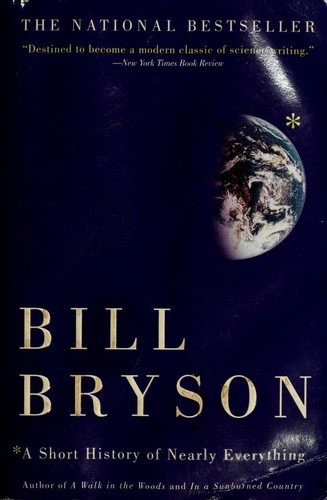
A Short History of Nearly Everything is Bill Bryson's attempt to understand the scientific story of everything — from the Big Bang to the emergence of modern humans — by spending three years talking to scientists and reading science history.
Bill Bryson · 2003 · 12h 0m
Full summary and key takeaways →The 12 questions
- 1.
Bryson argues that science history is full of overlooked and undervalued contributors. Who do you think deserves more credit than they've received in fields you know?
- 2.
The book emphasizes how recently many things were unknown or disputed. Does that make you more or less confident in current scientific consensus?
- 3.
What's the most surprising thing you learned from the book, or the claim that most challenged a prior assumption?
- 4.
Bryson tells science as a human story, full of personality and conflict. Does humanizing scientists help or undermine the idea that science produces objective knowledge?
- 5.
The plate tectonics story shows how a correct theory can be resisted for decades. What does that suggest about how the scientific community should handle heterodox ideas?
- 6.
Bryson calculates the improbability of your own existence across cosmic time. Did that calculation change how you think about ordinary life?
- 7.
The book covers geology, physics, chemistry, and biology in a single volume. Which field did you find most surprising or unfamiliar?
- 8.
Semmelweis was ridiculed for telling doctors to wash their hands. What present-day equivalents might history judge harshly in fifty years?
- 9.
Bryson is a travel writer, not a scientist. Does his outsider perspective make the book more or less authoritative?
- 10.
How does the timescale of the universe — 13.8 billion years — change how you think about human history, which covers roughly 200,000 years at most?
- 11.
The book ends with concern about how humans are affecting Earth's biosphere. Does that concern feel earned after everything you've read, or does it feel tacked on?
- 12.
If you could go back and witness one moment in the history of scientific discovery Bryson describes, which would it be?
How to run the discussion
- Pick six to eight, not all of them. An hour of real discussion covers fewer questions than anyone expects, and racing the list is what makes a book club feel like homework.
- Open with what people noticed, not what they concluded. Asking for a verdict first hardens opinions before anyone has heard each other.
- Let the disagreement run. The questions below that split a room are the ones worth the time; the ones everyone answers the same way can be skipped.
- Ask the quiet person a specific question. A direct, narrow question is far easier to answer than an open invitation to contribute.
Themes worth steering toward
If the conversation stalls, these are the threads that usually restart it.
Common questions
What are good book club questions for A Short History of Nearly Everything?
Here are 12 book club questions for A Short History of Nearly Everything by Bill Bryson, ordered to open easily and end somewhere worth arguing about. The strongest openers ask what each reader noticed rather than what they concluded, and the discussion usually turns on scientific history, cosmology, evolution.
How long should a book club discussion of A Short History of Nearly Everything last?
Most groups run 60 to 90 minutes of actual discussion. That is roughly six to eight questions, not all of them, so pick the ones that suit your group rather than working down the list in order.
What are the main themes in A Short History of Nearly Everything?
Scientific history, Cosmology, Evolution, Earth sciences, Human discovery. Those are the threads most likely to divide a room, which makes them the useful places to steer a discussion that has gone quiet.
Picking the next one? See books like A Short History of Nearly Everything or questions for other book club picks.
