Philosophy · Book club
A Swim in a Pond in the Rain book club questions
Here are 12 book club questions for A Swim in a Pond in the Rain by George Saunders, ordered to open easily and end somewhere worth arguing about. Copy them, print them, or bring them up one at a time.
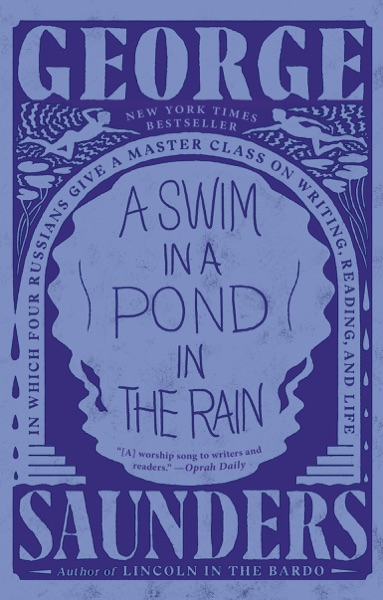
A Swim in a Pond in the Rain is George Saunders's account of the graduate fiction workshop he has taught at Syracuse for over twenty years, organized around seven stories by Tolstoy, Chekhov, Turgenev, and Gogol.
George Saunders · 2021 · 6h 45m
Full summary and key takeaways →The 12 questions
- 1.
Saunders structures the book around stories he teaches, not the ones he considers objectively greatest. What stories would you organize a writing class around, and what would that choice reveal about your values as a reader?
- 2.
The Prussian officer test assumes you can identify the moment a story loses you. Have you found that your own threshold for continuing is consistent, or does it vary unpredictably?
- 3.
Saunders argues that fiction works on the reader below the level of conscious thought. What's the last story that affected you in a way you couldn't fully explain?
- 4.
Chekhov withholds explanation and trusts the reader. Where in your own writing or communication do you over-explain rather than trust the reader or listener?
- 5.
Saunders says first drafts are for discovering what the story is about. Does that change how you think about starting any kind of creative or intellectual project, not just fiction?
- 6.
Gogol's absurdism in 'The Nose' reveals social anxieties more vividly than realism could. What contemporary anxieties do you think would best be exposed through absurdist rather than realistic treatment?
- 7.
He argues that the Russian writers were responding to enormous cultural pressures — censorship, serfdom, the collapse of traditional authority. How do those pressures shape what the stories could and couldn't say directly?
- 8.
What's the difference between reading as a reader and reading as a writer? Have you ever read the same book in both modes, and what changed?
- 9.
Saunders is honest that his pedagogy is empirical, not theoretical — this is what has worked in my classroom. Do you trust that kind of authority, or do you want a more principled foundation?
- 10.
The book is partly an argument that great stories produce ethical understanding without being didactic. Do you believe literature can actually change how people behave?
- 11.
Which of the seven Russian stories discussed in the book do you most want to read or re-read, based on Saunders's description? What drew you to it?
- 12.
He suggests that reading widely is less useful than reading one good story repeatedly until you fully understand what it's doing. Do you agree?
How to run the discussion
- Pick six to eight, not all of them. An hour of real discussion covers fewer questions than anyone expects, and racing the list is what makes a book club feel like homework.
- Open with what people noticed, not what they concluded. Asking for a verdict first hardens opinions before anyone has heard each other.
- Let the disagreement run. The questions below that split a room are the ones worth the time; the ones everyone answers the same way can be skipped.
- Ask the quiet person a specific question. A direct, narrow question is far easier to answer than an open invitation to contribute.
Themes worth steering toward
If the conversation stalls, these are the threads that usually restart it.
Common questions
What are good book club questions for A Swim in a Pond in the Rain?
Here are 12 book club questions for A Swim in a Pond in the Rain by George Saunders, ordered to open easily and end somewhere worth arguing about. The strongest openers ask what each reader noticed rather than what they concluded, and the discussion usually turns on craft, fiction writing, russian literature.
How long should a book club discussion of A Swim in a Pond in the Rain last?
Most groups run 60 to 90 minutes of actual discussion. That is roughly six to eight questions, not all of them, so pick the ones that suit your group rather than working down the list in order.
What are the main themes in A Swim in a Pond in the Rain?
Craft, Fiction writing, Russian literature, Storytelling, Meaning. Those are the threads most likely to divide a room, which makes them the useful places to steer a discussion that has gone quiet.
Picking the next one? See books like A Swim in a Pond in the Rain or questions for other book club picks.
