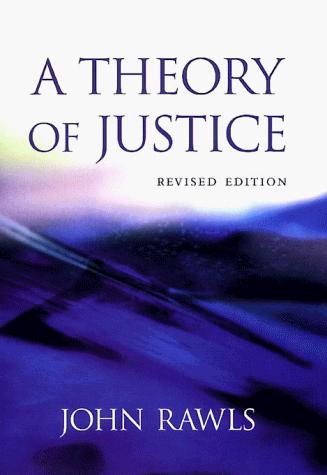
A Theory of Justice by John Rawls is a 1971 philosophy book about justice, fairness, political philosophy. The original position and veil of ignorance: just principles are those that rational agents would choose if they did not know their place in the distribution of natural talents, wealth, or social position.
Summary
A Theory of Justice, published in 1971, is John Rawls's attempt to construct a systematic alternative to utilitarianism in political philosophy. The book argues that a just society is one whose basic institutions could be chosen by rational agents behind a "veil of ignorance" — a thought experiment in which no one knows their place in society, their class, their natural abilities, or even their conception of the good. Rawls calls this the "original position," and argues that from behind the veil, rational persons would choose two principles: first, that everyone has equal basic liberties; second, that inequalities are only permissible if they are arranged to benefit the least advantaged members of society.
The second principle — the difference principle — is the book's most contested contribution. It doesn't demand strict equality, but it does demand that inequalities be justified from the perspective of those worst off. A society may permit doctors to earn more than custodians, but only if the arrangement, through training incentives and productivity, leaves the least advantaged better off than a more egalitarian alternative would. This is not charity but structural justice: the basic institutions of society are to be arranged according to what those who gain least from them could rationally accept.
Rawls also develops an account of the sense of justice and of what he calls a "well-ordered society" — one in which citizens understand and accept the principles of justice governing their institutions. He engages extensively with Kantian ethics, arguing that his contractualism provides a more plausible framework for impartiality than utilitarian maximization, which can in principle sacrifice individual rights for aggregate welfare.
The book is long, technical, and not written for general audiences. The most practically accessible parts are the original position thought experiment, the two principles and their derivation, and the critique of utilitarianism in Part I. Parts II and III, on institutions and on the concept of goodness, are denser and more contested. The book reshaped political philosophy in ways that are still playing out — virtually every significant work in liberal political philosophy since 1971 has had to engage with Rawls — but it is a demanding text that rewards patient, selective reading.
Talk to A Theory of Justice like its author wrote you back.
Get the ideas that fit your life — not generic summaries.
- Chat with the book
- Audiobook-style main ideas
- Adapts to your life and goals
- Helps you take action
Key takeaways
- 1.
The original position and veil of ignorance: just principles are those that rational agents would choose if they did not know their place in the distribution of natural talents, wealth, or social position.
- 2.
Rawls's first principle of justice requires equal basic liberties for all — freedom of speech, conscience, assembly, and the rule of law — and these cannot be traded off against economic advantages.
- 3.
The difference principle holds that social and economic inequalities are just only if they benefit the least advantaged members of society. Inequality must be justified from below, not above.
- 4.
Rawls is explicitly anti-utilitarian: justice cannot permit the violation of individual rights simply because doing so maximizes aggregate welfare. The separateness of persons places limits on aggregation.
- 5.
The concept of primary goods — liberties, opportunities, income, wealth, and the bases of self-respect — provides a metric for evaluating how well individuals fare under different institutional arrangements.
- 6.
A well-ordered society is not merely one with just institutions, but one in which citizens understand the principles of justice and have a stable sense of justice that motivates compliance.
- 7.
Justice as fairness is explicitly constructivist: the principles of justice are not discovered in nature but constructed through the original position procedure, which models the conditions of impartiality.
- 8.
Rawls acknowledges that the original position is a device of representation, not a description of an actual historical contract — it is a way of modeling what impartiality requires, not a literal agreement.
Discussion questions
Use these on your own, with a book club, or as chat starters in Superbook. Book club version, ready to copy or print →
- 1.
Behind the veil of ignorance, Rawls argues you would choose the difference principle. Would you? Is maximin — protecting the worst case — the rational strategy, or is it too risk-averse?
- 2.
The difference principle says inequalities are just only if they benefit the least advantaged. Can you think of actual institutional arrangements that satisfy this criterion? Which ones fail it?
- 3.
Rawls insists that basic liberties take priority over economic equality. Is that priority ordering intuitively right, or can you construct cases where trading off some liberty for greater equality seems justified?
- 4.
Utilitarianism might in principle sacrifice one person for the greater good. Rawls says this fails to take seriously the separateness of persons. Is the separateness of persons argument convincing?
- 5.
The original position is designed to model impartiality. Does it actually achieve that, or does it smuggle in particular assumptions about what matters under the guise of neutrality?
- 6.
How does Rawls's theory apply to global justice? The original position was designed for a single closed society. Does it extend to international inequality?
- 7.
The difference principle requires institutions, not just individual decisions, to be shaped around the interests of the least advantaged. What would that actually look like in practice in a contemporary democracy?
- 8.
Rawls distinguishes between the concept of justice and particular conceptions of it. Is that distinction useful, or does it allow the theory to be so abstract it can't be applied?
- 9.
Robert Nozick argued that Rawls's framework ignores how holdings arise through voluntary exchange. Does the process by which inequalities arise matter, independent of their pattern?
- 10.
Rawls requires a sense of justice that is stable across generations. Is that kind of civic culture producible, or does it rely on conditions that are rarely met?
- 11.
The original position assumes rational self-interest behind the veil of ignorance. Does that make the theory fundamentally individualist in a way that sits uneasily with communitarian values?
- 12.
Which of Rawls's arguments do you find most persuasive, and which feels like the weakest link in the chain?
Themes
Frequently asked questions
-
What is the veil of ignorance?
It is a thought experiment in which you imagine choosing the principles for a just society without knowing your place in that society — your wealth, natural talents, race, gender, or even your values. Rawls argues that principles chosen under these conditions would be genuinely fair, because no one could shape them to benefit their particular position.
-
How long is A Theory of Justice?
Over 600 pages in the revised edition. It is a major scholarly work, not casual reading. Many readers focus on Part I, which contains the original position, the two principles, and the critique of utilitarianism — about 150 pages — before deciding how deeply to go into Parts II and III.
-
What is the difference principle?
It is Rawls's second principle of justice: that social and economic inequalities are only just if they are arranged to the greatest benefit of the least advantaged members of society. Inequality is permissible but must be justified from the perspective of those who gain least from the existing arrangement.
-
Is A Theory of Justice accessible to non-philosophers?
Partly. The original position and the difference principle can be grasped without specialist training. The detailed engagement with Kant, the theory of primary goods, and the account of a well-ordered society require more patience. Rawls's own Justice as Fairness: A Restatement is a shorter, more accessible version of the core argument.
-
What is the main objection to Rawls?
Several are prominent. Libertarians, particularly Robert Nozick in Anarchy, State, and Utopia, argued that the difference principle permits redistribution that violates property rights arising from voluntary exchange. Communitarians argued the original position assumes an artificially thin, unencumbered self. Egalitarians argued the difference principle permits too much inequality. Each of these objections has generated a substantial literature.