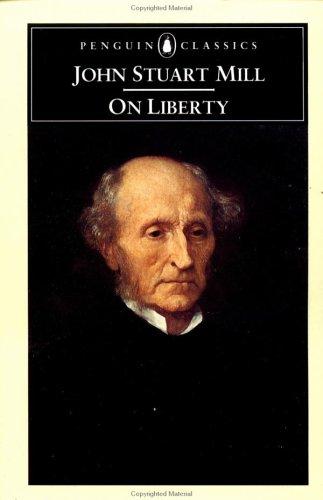
On Liberty by John Stuart Mill is a 1859 philosophy book about individual freedom, political authority, free speech. The harm principle: society may only coerce individuals to prevent harm to others. Paternalistic interference to protect people from themselves is illegitimate.
Summary
On Liberty, published in 1859, is John Stuart Mill's defense of individual freedom against both governmental coercion and social pressure. Mill begins with what he calls the "very simple principle" — also known as the harm principle — that the only legitimate reason for society to interfere with an individual's freedom of action is to prevent harm to others. Harm to oneself is not sufficient justification. This sounds simple, but Mill spends the rest of the essay mapping its implications across speech, conduct, and the relationship between individual development and collective welfare.
The chapter on freedom of thought and discussion is the most celebrated and is worth reading as a stand-alone argument. Mill makes four claims for why expression should be free even when it is false or offensive. First, the censored opinion might be true. Second, even if false, it likely contains a partial truth. Third, even if entirely false, free contestation prevents true beliefs from becoming dead dogmas — comfortable slogans that no one genuinely understands because they have never had to defend them. Fourth, and most practically, suppression of dissent tends to suppress the person doing the dissenting, not merely the idea.
Mill also argues for what he calls individuality — the development of one's distinctive capacities and character — as a good in itself, not merely instrumentally. A society that produces well-behaved conformists at the cost of individual originality is losing something essential. The argument here draws on Humboldt and anticipates later liberal thought about autonomy and self-creation.
The essay has real weaknesses. Mill's utilitarianism is in some tension with his defense of individual rights: he wants to ground liberty in general welfare, but individual freedom sometimes conflicts with majority welfare in ways the harm principle does not cleanly resolve. His applications of the principle to particular cases — education, marriage, trade regulation — are sometimes more tentative and inconsistent than the general argument suggests. And his explicitly paternalistic exceptions (civilized nations may act otherwise toward those not yet in the maturity of their faculties) are among the most contested passages in nineteenth-century political philosophy.
Talk to On Liberty like its author wrote you back.
Get the ideas that fit your life — not generic summaries.
- Chat with the book
- Audiobook-style main ideas
- Adapts to your life and goals
- Helps you take action
Key takeaways
- 1.
The harm principle: society may only coerce individuals to prevent harm to others. Paternalistic interference to protect people from themselves is illegitimate.
- 2.
Freedom of thought and expression is defended on four grounds: the suppressed view may be true; it may contain partial truth; free contestation prevents true beliefs from becoming dead dogmas; and suppression harms the dissenter.
- 3.
Individuality — the development of one's distinctive capacities — is a social good, not merely a private one. Conformist societies lose the originality that drives progress.
- 4.
Mill distinguishes between areas of life that are primarily self-regarding and those that affect others, and argues that authority can only legitimately govern the latter.
- 5.
A received truth contested by error is better understood and more genuinely held than a received truth that has never been challenged.
- 6.
Social tyranny — the pressure of custom, convention, and collective opinion — can be as oppressive as legal coercion, and is in some ways harder to resist.
- 7.
Mill is aware that the harm principle leaves many hard cases unresolved: its application requires judgment about what counts as harm and who counts as affected.
- 8.
The argument for liberty is ultimately utilitarian for Mill: free societies develop better because they allow experiment, originality, and the correction of error — but this grounds liberty in welfare rather than rights, which creates tensions.
Discussion questions
Use these on your own, with a book club, or as chat starters in Superbook. Book club version, ready to copy or print →
- 1.
The harm principle sounds simple. Can you think of cases where it is genuinely difficult to apply — where the line between self-regarding and other-regarding action is unclear?
- 2.
Mill argues that a true belief that has never been challenged becomes a dead dogma. Do you think that's an accurate description of how people relate to uncontested convictions?
- 3.
How does the distinction between legal coercion and social pressure affect Mill's argument? Is the harm principle as useful against the latter as against the former?
- 4.
Mill's fourth argument for free speech — that suppression harms the dissenter — is often overlooked. How does it change the analysis of modern debates about content moderation?
- 5.
Mill defends individuality partly on social grounds — diverse people generate better ideas and progress. Does that kind of instrumental defense feel stable, or does it invite the objection that individuality is only worth protecting when it's productive?
- 6.
Mill includes a paternalistic exception for societies not yet in 'the maturity of their faculties.' How do you evaluate that exception, and what does it reveal about the argument's foundations?
- 7.
Think of an area of your own life where you feel the pressure of social conformity more than legal coercion. How does Mill's framework apply there?
- 8.
On Liberty was jointly shaped by Mill's collaboration with Harriet Taylor. Does acknowledging that co-authorship change how you read the arguments?
- 9.
Mill says a person's liberty extends only to actions that are primarily self-regarding. Is there such a thing, or is every personal choice entangled with effects on others?
- 10.
The free speech arguments in On Liberty were written for an era without broadcast media, social platforms, or algorithmic amplification. Which parts of the argument survive that change, and which don't?
- 11.
Mill defends eccentricity and nonconformity as valuable to society. Do you think modern liberal democracies actually protect eccentricity, or do they substitute new forms of conformism for old ones?
- 12.
How does Mill's grounding of liberty in utility — rather than in rights — create vulnerabilities in the argument? Are those vulnerabilities fatal?
Themes
Frequently asked questions
-
What is On Liberty about?
It is Mill's argument for limiting the power of society and government over individual thought, expression, and action. The central principle is that coercion is only legitimate to prevent harm to others. The essay is also a defense of free speech and of the value of individual originality and nonconformity.
-
How long does it take to read On Liberty?
About three to four hours. The essay is roughly 150 pages and written in sustained Victorian prose that rewards careful reading but does not require specialist background. The chapter on free expression is often read on its own and takes about an hour.
-
Is Mill's harm principle still relevant today?
Very much so. It underlies ongoing debates about free speech, hate speech regulation, drug policy, seatbelt laws, and the limits of government. The principle is widely invoked but rarely precisely applied, partly because drawing the line between self-regarding and other-regarding actions is harder than it sounds.
-
Do you need to be a utilitarian to accept Mill's argument in On Liberty?
No. Mill grounds his case in utility, but the argument for free expression and individual development can be reconstructed on rights-based or autonomy-based grounds. Many liberal political philosophers who reject utilitarianism accept the substance of On Liberty's conclusions.
-
What is the strongest objection to On Liberty?
The harm principle is genuinely difficult to apply, and Mill's own applications are inconsistent. Critics also argue that grounding liberty in welfare creates a standing tension: if, in particular cases, restricting freedom maximized general welfare, Mill's utilitarian foundations would seem to permit it. He never fully resolved that tension.
Similar books
The Federalist Papers
Alexander Hamilton, James Madison, and John Jay
Democracy in America
Alexis de Tocqueville

On Tyranny: Twenty Lessons from the Twentieth Century
Timothy Snyder
Enlightenment Now
Steven Pinker
